
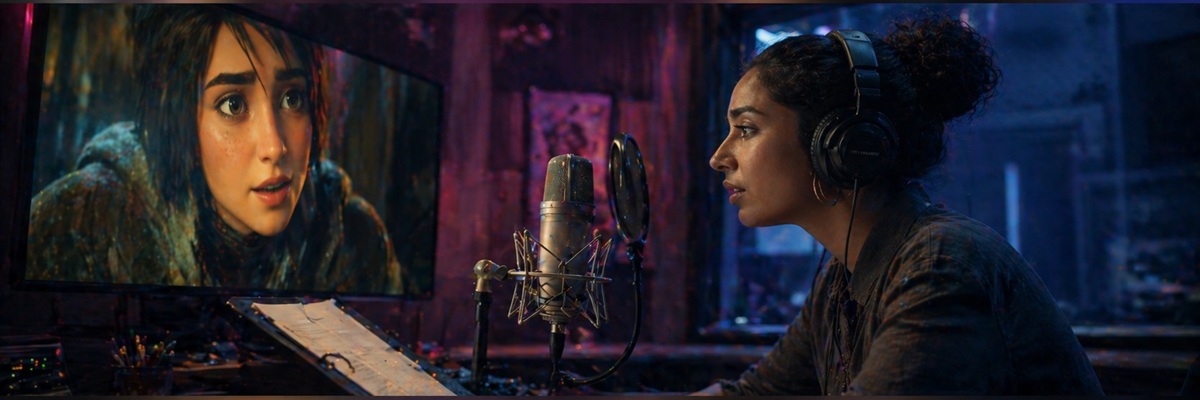
Dubbing is often perceived as a straightforward process. A voice replaces another, dialogue is translated, and the content moves across languages. In practice, dubbing is one of the most technically demanding forms of voice performance.
Every line must fit within strict timing. Every emotion must align with what is already on screen. The performance is shaped by constraints that do not exist in other areas of voice acting. The result, when done well, feels natural and unforced. When it falls short, the disconnect is immediate.
This balance between precision and performance defines the craft of dubbing.
Timing and Lip Sync in Dubbing Performance
One of the most visible challenges in dubbing is lip sync. Dialogue must match the mouth movements of the original actor, even when the translated language has a different structure.
This requires constant adjustment. Sentences may need to be shortened or expanded to fit the available time. Words must align with visible mouth shapes, especially in close-up shots where mismatches are more noticeable.
The challenge becomes more complex across languages. Some languages naturally take longer to express the same idea, while others are more compact. That challenge becomes even more noticeable in productions with diverse voiceover casts, where actors from different linguistic and performance backgrounds still need to maintain tonal consistency across the same scene. Dubbing actors must adapt their delivery to fit the timing without making the dialogue feel rushed or unnatural.
This constraint shapes the performance itself. It is not just about what is being said, but how it fits into a fixed visual framework. Every line is delivered with an awareness of timing that goes beyond standard narration or character work.
Emotional Alignment with the Original Actor
Dubbing requires a close alignment with the original performance. The emotional tone of each scene must remain consistent, even though the voice has changed.
This does not mean imitation. The goal is not to copy the original actor’s voice, but to match the intent behind the performance. A scene that carries tension, humor, or vulnerability needs to feel the same in the dubbed version.
Small differences in delivery can shift how a scene is perceived. A slightly stronger emphasis can make a line feel more dramatic. A softer delivery can change the tone entirely. These adjustments must be controlled to maintain the balance of the original.
Consistency is also important across the full production. Characters develop over time, and their emotional range needs to remain stable from one scene to the next. Dubbing actors must track these shifts while working within the constraints of translated dialogue.
Balancing Natural Delivery with Technical Limits
One of the core challenges in dubbing is maintaining natural speech within strict technical limits.
Dialogue needs to sound as if it belongs in the target language. At the same time, it must fit the timing and structure dictated by the original performance. This creates a constant balance between accuracy and flow.
If the translation is followed too closely, the result may feel rigid or unnatural. If the delivery is adjusted too freely, it may fall out of sync with the visuals. The performance sits between these two points, shaped by both linguistic and technical considerations.
Experienced dubbing actors develop an instinct for this balance. They adjust pacing, phrasing, and emphasis in ways that are not immediately noticeable to the listener. The goal is to create a version that feels seamless, even though it is built within constraints.
This is where the craft becomes less visible. The more natural the performance feels, the less the audience notices the work behind it.
Character Continuity Across Episodes and Releases
Dubbing often involves long-term projects. Television series, film franchises, and ongoing productions require actors to return to the same roles over extended periods.
Maintaining consistency becomes essential. The voice of a character needs to remain stable, even if recordings are separated by months or years. This includes tone, pacing, and character-specific choices made in earlier sessions.
Actors may revisit previous recordings to match their delivery. Subtle details, such as how a character expresses certain emotions or handles specific phrases, need to be preserved.
This continuity is particularly important for audiences who follow a series over time. Any noticeable shift in performance can disrupt the sense of familiarity that builds around a character.
The ability to maintain this level of control over long periods is a defining skill in dubbing work.
Why This Craft Often Goes Unnoticed
The goal of dubbing is to feel invisible. When it works, the audience focuses on the story rather than the adaptation.
This invisibility contributes to the lack of recognition for dubbing actors. The performance is designed to blend into the original production, not stand apart from it. Success is measured by how little the audience notices the transition between languages.
At the same time, this makes the work more demanding. Every detail must align closely with the source material, leaving little room for error. The performance operates within a narrow margin, where precision defines quality.
The result is a form of acting that is both highly controlled and widely experienced, even if it is not always acknowledged.
Dubbing is performance shaped by limitation. Timing, structure, and alignment all influence how a line is delivered. Within those limits, actors create performances that carry the intent of the original work into a new language.
The process requires discipline, adaptability, and attention to detail. When done well, it allows stories to move across cultures without losing their impact.
That outcome may feel effortless to the audience, but it is built on a level of craft that remains largely behind the scenes.
