The Harry Potter series has been reimagined many times, through films, stage productions, and illustrated editions. In 2025, the franchise took another significant step with the release of its full-cast audiobooks, a project that moved away from the traditional single-narrator format and into something far more cinematic.
Now, with multiple installments released and widely circulated, the project has settled into the current audiobook landscape as one of the most ambitious voice-driven productions to date. What began as a bold experiment has turned into a clear signal of where large-scale audiobook storytelling is heading.
From Single Narrator to Cinematic Ensemble
For years, Harry Potter audiobooks were defined by two voices. Stephen Fry in the UK and Jim Dale in the US carried the entire series, voicing dozens of characters while maintaining narrative continuity across all seven books.
That approach became the standard for audiobook storytelling. One performer, one consistent tone, and a performance built on vocal versatility.
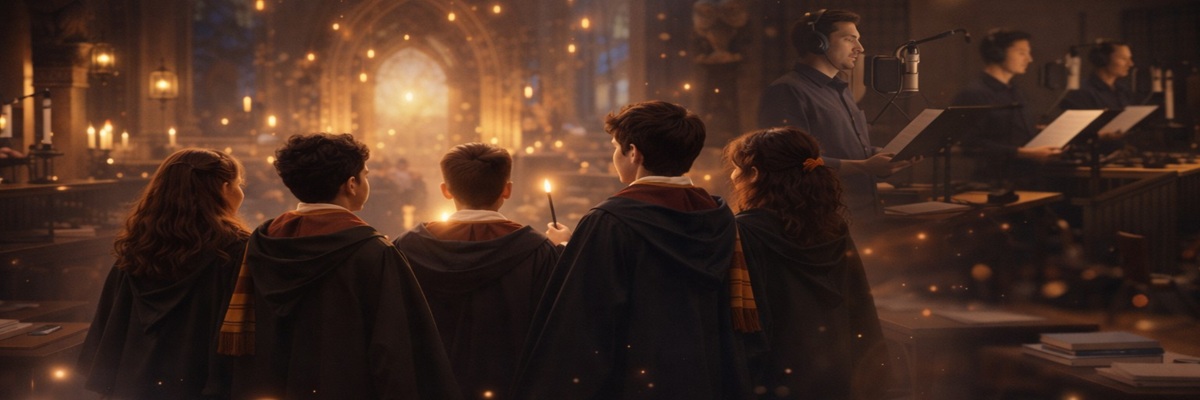
The new full-cast editions take a different route. Instead of relying on a single narrator, the series now uses an ensemble of voice actors, each assigned to specific roles. Dialogue is distributed across performers, and the production includes layered sound design, music cues, and environmental effects.
This shift changes how the story is experienced. Scenes feel more immediate, with interactions unfolding in real time rather than being filtered through one voice. It moves the format closer to audio drama while still retaining the structure of the original text.
For listeners familiar with the earlier versions, the difference is noticeable from the first chapter.
The Full Voice Cast and Key Performers
One of the defining features of this project is its scale. The Harry Potter full-cast audiobooks bring together a wide range of performers, from established screen actors to experienced voice talent.
Among the most widely discussed additions is Keira Knightley, whose involvement drew attention both for her star power and the broader conversation surrounding her participation. High-profile casting like this signals how seriously platforms are approaching audiobook production, particularly for major franchises.
The cast also includes a mix of seasoned voice actors and performers with backgrounds in film, television, and stage. This combination allows the production to balance recognizable voices with those trained specifically in long-form audio performance.
Rather than listing every character through a single narrator’s interpretation, the series assigns distinct voices to key roles across the story. Harry, Hermione, Ron, Dumbledore, Snape, and many others are each shaped by different performers, giving the world a more layered vocal identity.
This approach mirrors what audiences are used to in animation and film, where each character carries a separate performance. In audio form, it creates a sense of scale that matches the size of the Wizarding World.
Reception and Performance Since Release
Since its release, the full-cast Harry Potter audiobooks have performed strongly across major audio platforms, particularly on Audible. While exact sales figures are not always disclosed, the series has consistently appeared in top audiobook rankings and has generated significant listener engagement.
Audience response has been divided in a way that reflects the project’s ambition.
Many listeners have embraced the immersive quality of the production. The use of multiple voices and sound design has made the story feel more immediate, particularly for newer audiences who may not have grown up with the original audiobooks.
At the same time, longtime listeners often compare the new versions to the performances by Stephen Fry and Jim Dale. Those earlier interpretations remain deeply associated with the series, and for some, they continue to define how the story should sound.
This split reaction is not unusual. Whenever a well-established format changes, especially one tied to a major franchise, comparisons are inevitable. What stands out is that the new editions have still managed to carve out their own audience, rather than simply replacing the originals.
The rollout of the series has also kept interest steady, with releases spaced in a way that allows each installment to maintain attention before the next arrives.
A Turning Point for Voice Acting in Audiobooks
The Harry Potter full-cast audiobooks represent more than a franchise update. They mark a shift in how audiobook production is being approached at the highest level.
Traditionally, audiobooks have been narrator-driven. Even when multiple voices were used, the structure still centered on a primary storyteller. This new model moves toward performance-based casting, where each character contributes to the narrative through individual interpretation.
For voice actors, this creates a different set of opportunities. Instead of carrying an entire book, performers can focus on specific roles, similar to animation or game work. This opens the door for more actors to be involved in a single project, particularly in large-scale productions.
At the same time, it raises expectations. Consistency across performances becomes critical, as each voice must fit within the overall tone of the story. Direction, pacing, and editing all play a larger role in ensuring that the final product feels cohesive.
The success of projects like this suggests that full-cast audiobooks are not a one-time experiment. They are becoming part of a broader shift toward more immersive audio storytelling.
Franchise Casting and Public Attention
With larger productions come larger conversations. The inclusion of well-known actors like Keira Knightley brought attention beyond the usual audiobook audience, but it also introduced public scrutiny.
Casting decisions tied to major franchises often generate discussion that goes beyond performance. Audience reactions can be influenced by expectations, previous associations with the material, or broader conversations surrounding the franchise itself.
In this case, the focus has remained largely on how the performances contribute to the overall experience. Still, the visibility of the project shows how audiobook casting is moving into a space that was once reserved primarily for film and television.
Voice actors working on projects of this scale are no longer operating behind the scenes in the same way. Their involvement becomes part of the broader narrative around the release.
A New Benchmark for Audiobook Storytelling
The Harry Potter full-cast audiobooks have established a new benchmark for what large-scale audio productions can achieve.
By combining a well-known story with an ensemble cast and cinematic production techniques, the project demonstrates how audiobooks can evolve without losing their core appeal. The story remains the same, but the way it is delivered continues to change.
For the voiceover industry, this signals a growing demand for performance-driven audio. As more franchises explore similar formats, the role of voice actors in long-form storytelling is likely to expand.
Harry Potter has always been a defining property in entertainment. With these full-cast audiobooks, it is now helping shape the next phase of how stories are heard.
