
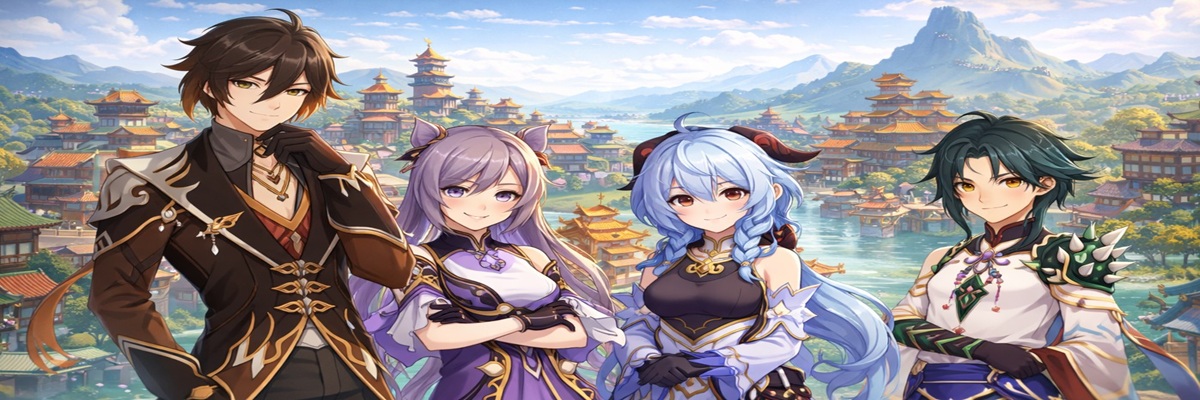
After establishing its tone with Mondstadt, Genshin Impact expanded its world with a dramatically different atmosphere in its next major update. Where the first region leaned into lightness and adventure, the second introduced a more grounded, culturally rooted style of storytelling. The shift was not only visual or narrative. It was vocal.
As discussed in the previous article on Mondstadt’s cast, HoYoverse’s multilingual production model plays a major role in the game’s global success. This next chapter deepened that approach. The performances became more measured, authoritative, and emotionally restrained, reflecting a society built on contracts, commerce, and history. The result was a noticeable evolution in how voice acting shaped the identity of Genshin Impact.
A Clear Shift in Vocal Direction
The tonal contrast between the first and second major regions is immediately apparent. Dialogue pacing slows. Characters speak with deliberation. Authority figures carry weight in their delivery. Humor is more subtle, often rooted in wit rather than overt enthusiasm.
This difference is particularly pronounced in the Chinese voice track, which carries cultural nuance tied to the region’s inspiration. However, the English and Japanese casts also reflect that shift. Performers adopt calmer, deeper, and more composed tones. Emotional peaks are still present, but restraint defines much of the region’s vocal identity.
This approach elevated the game’s maturity. Rather than repeating the bright energy of its opening chapter, the developers allowed voice direction to mirror the region’s philosophical foundation. Contracts, tradition, and legacy became thematic anchors, and the vocal performances reinforced that structure.
Zhongli and the Power of Gravitas
No character represents this shift more clearly than Zhongli. As the Geo Archon, his presence became instantly iconic. His voice performance stood out not only within the game but across gaming communities and streaming platforms.
Zhongli’s delivery is calm, deliberate, and resonant. Streamers frequently commented on the depth of his voice, and compilations of his lines circulated widely online. His performance became a defining example of how strong vocal direction can elevate character perception.
Zhongli Voice Actors:
- English: Keith Silverstein
- Japanese: Tomoaki Maeno
- Chinese: Peng Bo
Keith Silverstein’s English portrayal emphasizes warmth layered over authority. Tomoaki Maeno brings refined composure in Japanese, while Peng Bo’s Chinese performance anchors the character in cultural authenticity. Across all three versions, Zhongli’s voice communicates history and power without raising volume.
His popularity among streamers and content creators helped amplify the game’s reach. Reaction videos and character showcases often highlighted his vocal presence as much as his gameplay mechanics.
Five-Star Performances and Vocal Identity
Beyond Zhongli, several five-star characters reinforced the region’s distinct voice profile. These performances balance elegance, intensity, and emotional restraint.
Ganyu Voice Actors:
- English: Jennifer Losi
- Japanese: Reina Ueda
- Chinese: Lin Su
Ganyu’s soft yet controlled delivery reflects her dual nature as both adeptus and secretary. Her tone contrasts sharply with earlier energetic characters.
Xiao Voice Actors:
- English: Laila Berzins
- Japanese: Yoshitsugu Matsuoka
- Chinese: Kinsen
Xiao’s performance carries internal conflict. The Japanese track leans into sharp emotional intensity, while the English version maintains a guarded detachment.
Keqing Voice Actors:
- English: Kayli Mills
- Japanese: Eri Kitamura
- Chinese: Xie Ying
Keqing’s assertive delivery emphasizes independence and skepticism. Her dialogue pacing is brisk yet controlled.
Ningguang Voice Actors:
- English: Erin Ebers
- Japanese: Sayaka Ohara
- Chinese: Du Mingya
Ningguang’s composed authority stands out. All three versions convey intelligence and calculated power.
Tartaglia Voice Actors:
- English: Griffin Burns
- Japanese: Ryohei Kimura
- Chinese: Yudong
Though not native to the region, Tartaglia’s role in its storyline adds vocal contrast. His energetic tone disrupts the otherwise measured atmosphere.
These five-star performances collectively raised expectations for character-driven storytelling within the game.
Supporting Characters and Cultural Texture
The supporting cast further enriched the region’s voice landscape. While five-star characters often dominate attention, four-star units contributed tonal variety.
Xiangling Voice Actors:
- English: Jackie Lastra
- Japanese: Yuu Sasahara
- Chinese: Xiao N
Chongyun Voice Actors:
- English: Beau Bridgland
- Japanese: Soma Saito
- Chinese: Qin Qiege
Beidou Voice Actors:
- English: Allegra Clark
- Japanese: Ami Koshimizu
- Chinese: Tang Yajing
Qiqi Voice Actors:
- English: Christie Cate
- Japanese: Yukari Tamura
- Chinese: Yan Ning
These characters bring balance. Beidou’s confident tone contrasts with Qiqi’s soft detachment. Xiangling’s lively enthusiasm injects warmth into an otherwise composed environment. Even comedic moments feel rooted in cultural texture rather than exaggerated delivery.
The Chinese voice track often serves as a tonal anchor due to the region’s inspiration. However, English and Japanese versions maintain fidelity while adapting to their respective performance traditions.
Streamers and the Rise of Vocal Recognition
Streaming culture played a major role in amplifying these performances. Character reveals, wish pulls, and story reactions frequently centered on vocal impact. Zhongli’s voice became a recurring topic in live chats and highlight reels. Voice lines were quoted, remixed, and meme-ified.
This exposure reinforced how essential voice acting is in gacha games. Unlike traditional RPGs, where story may conclude after dozens of hours, Genshin Impact relies on ongoing character attachment. Streamers helped turn standout performances into community talking points.
Elevating the Game’s Narrative Scope
The second major region marked a maturation in voice direction. Emotional restraint replaced overt enthusiasm. Authority figures carried weight through tone alone. Cultural influence shaped cadence and inflection.
By diversifying vocal styles between regions, Genshin Impact avoided tonal stagnation. The game demonstrated that world-building extends beyond visuals and mechanics. Voice acting became a structural pillar, not simply a supporting feature.
As later regions introduced darker themes and more experimental storytelling, this chapter proved that performance depth could evolve alongside gameplay ambition. The multilingual cast ensured that players worldwide could experience that evolution through voices that felt intentional and grounded.
In the broader landscape of gacha RPGs, this shift set a precedent. Character identity is not defined only by design or rarity. It is defined by performance.
