
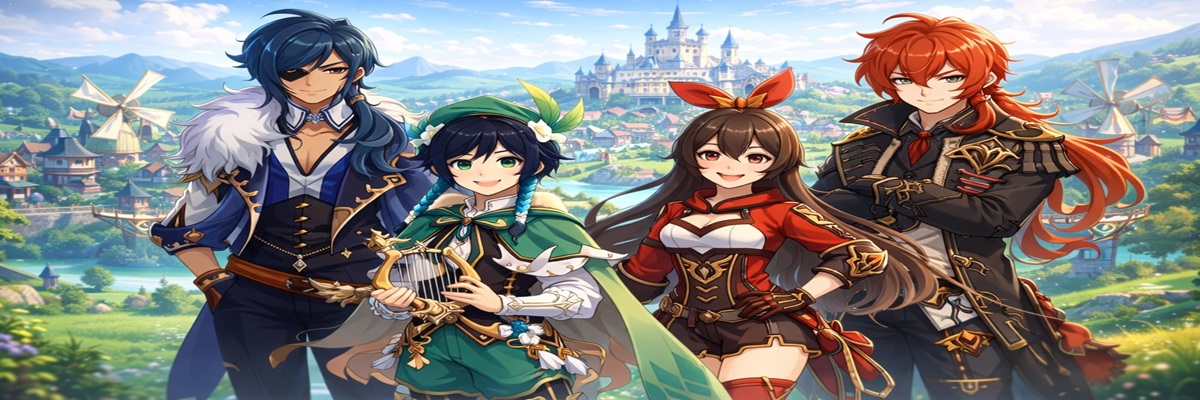
When Genshin Impact launched in 2020, it quickly became one of the most successful free-to-play RPGs in the world. Developed by HoYoverse, the open-world action title blended exploration, elemental combat, and a gacha-based character system across PC, mobile, and PlayStation platforms. Its success reshaped the global perception of live-service anime-inspired games and influenced titles that followed, including Arknights and Honkai: Star Rail.
One of the defining features of Genshin Impact from the start was its fully voiced cast in multiple languages. Players could choose between Japanese, English, Chinese, and Korean voice tracks, each featuring experienced performers. The first region introduced in the game, Mondstadt, set the tone for this multilingual approach. Inspired by European medieval architecture and known as the City of Freedom, Mondstadt served as players’ introduction to Teyvat and remains one of the most beloved regions.
Mondstadt and Its Archon Venti
At the center of Mondstadt’s storyline is Venti, the Anemo Archon. Disguised as a carefree bard, Venti plays a pivotal role in the region’s early narrative arc. His personality balances mischief, melancholy, and hidden wisdom.
In Japanese, Venti is voiced by Ayumu Murase, a performer known for energetic and emotionally layered roles in anime and games. His youthful tone and expressive delivery give Venti both charm and depth.
In English, Venti is voiced by Erika Harlacher, whose work spans numerous anime dubs and video games. Her portrayal emphasizes Venti’s playful side while still capturing the gravity beneath the character’s carefree exterior.
Venti also has dedicated Chinese and Korean voice actors, reflecting the game’s commitment to full localization. While English and Japanese performances are most discussed internationally, all four language tracks are recorded independently rather than dubbed from one another.
As Mondstadt’s Archon and a five-star character, Venti established the benchmark for the region’s vocal identity.
Mondstadt Launch Characters and Their Voices
Mondstadt introduced players to a large ensemble at launch, many of whom remain core to the game’s popularity.
Jean, the Acting Grand Master of the Knights of Favonius, is voiced in Japanese by Chiwa Saito and in English by Stephanie Southerland. Jean’s disciplined and composed demeanor is reflected in both performances.
Diluc, the brooding owner of Dawn Winery and a powerful Pyro five-star character, is voiced in Japanese by Kensho Ono and in English by Sean Chiplock. Both actors bring intensity and restraint to Diluc’s guarded personality.
Kaeya, the charismatic cavalry captain, is voiced in Japanese by Kosuke Toriumi and in English by Josey Montana McCoy. His smooth delivery in both languages complements the character’s layered motivations.
Amber, Mondstadt’s enthusiastic Outrider, is voiced in Japanese by Manaka Iwami and in English by Kelly Baskin. While Amber represents Mondstadt’s energetic optimism, later regions introduced very different character archetypes, including Dehya from Sumeru, voiced by Amber May, one of several professional black female voice actors who have become increasingly visible in major RPG casts. Her bright and optimistic tone helps anchor the game’s early hours.
Lisa, the intellectual librarian, is voiced in Japanese by Rie Tanaka and in English by Mara Junot. Both performances highlight Lisa’s confident and teasing personality.
Barbara, the idol of Mondstadt, is voiced in Japanese by Akari Kito and in English by Laura Stahl. Her gentle delivery contrasts with the more battle-hardened members of the Knights.
Other launch characters include Razor, Fischl, Bennett, Noelle, and Sucrose. While not all are five-star units, they gained popularity through their personalities and gameplay roles. For major favorites like Fischl, voiced in Japanese by Maaya Uchida and in English by Brittany Cox, the theatrical delivery became a defining trait. Chinese and Korean voice casts also brought distinct interpretations to these characters, reinforcing Mondstadt’s international reach.
Later Additions to Mondstadt
Following the initial release, Mondstadt received additional characters through updates and limited banners.
Albedo, the mysterious Chief Alchemist and a five-star Geo character, became one of the most prominent additions. He is voiced in Japanese by Nojima Kenji and in English by Khoi Dao. Both performances emphasize Albedo’s calm intelligence and subtle detachment.
Eula, the Spindrift Knight, is voiced in Japanese by Rina Sato and in English by Suzie Yeung. Her refined yet emotionally conflicted portrayal resonated strongly with players.
Rosaria, Mika, and other Mondstadt-affiliated characters expanded the region’s story and roster. For five-star characters, the Japanese and English casts often include recognizable anime and game actors, while Chinese and Korean tracks continue to deliver regionally authentic performances.
These later additions reinforced Mondstadt’s identity even as the game introduced new regions such as Liyue and Inazuma.
Multilingual Casting and Global Appeal
From its first update onward, Genshin Impact maintained full multilingual voice production. Rather than translating from a single master track, HoYoverse records separate performances in Japanese, English, Chinese, and Korean.
The Japanese cast often includes prominent anime voice actors, attracting fans familiar with major series. The English cast draws from established Western game and dubbing talent, creating accessibility for global audiences. Chinese and Korean recordings ensure authenticity for players in key markets.
This approach distinguished Genshin Impact from earlier RPGs that frequently prioritized a single language track. The multilingual strategy helped broaden its international appeal and set expectations for later gacha games.
Mondstadt’s Lasting Influence
As the first region players encounter, Mondstadt carries a unique emotional weight. Its characters introduced the world’s tone, humor, and stakes. The strength of the voice performances played a major role in that connection.
From Venti’s layered performance to Diluc’s restrained intensity and Jean’s composed leadership, the region’s cast demonstrated the importance of voice acting in modern live-service RPGs. As Genshin Impact continues expanding with new regions and characters, Mondstadt remains the foundation upon which its global success was built.
In future installments of this series, attention can turn to Liyue and the voice actors who shaped its distinct cultural and narrative presence.
