
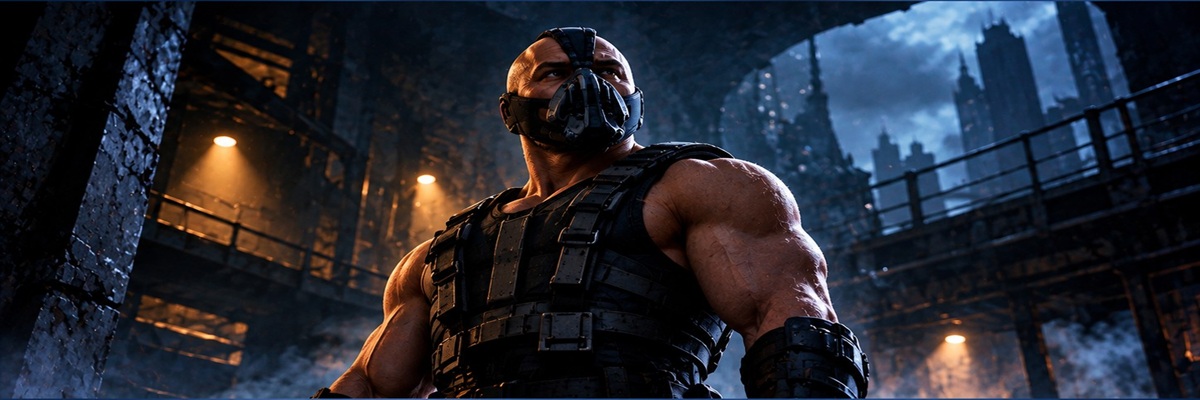
Michael Mando approached Bane differently than audiences might expect from an actor entering a recording booth. Before his first session for Batman: Knightfall Part 1: Knightfall, he memorized the entire script.
The actor, known for playing Nacho Varga in Better Call Saul and Vaas Montenegro in Far Cry 3, voices the formidable Batman villain in Warner Bros. Animation’s adaptation of the landmark Knightfall comic storyline. Mando joined supervising producer Rick Morales and producer Jim Krieg at San Diego Comic-Con 2026 to discuss the project, with additional interviews from the convention continuing to appear throughout August.
Those conversations revealed how seriously Mando approached a character who could easily be defined by his physical size and reputation for breaking Batman. Rather than beginning with an imitation of a previous Bane or arriving with a predetermined vocal effect, Mando immersed himself in the character and the script. The distinctive voice emerged from that preparation once recording actually began.
Michael Mando Takes On the Man Who Broke the Bat
Bane occupies an unusual position among Batman’s villains. Although his immense physical strength is an obvious part of the character, the original Knightfall storyline established him as a patient strategist capable of understanding Batman well enough to systematically dismantle him.
Instead of simply attacking the Dark Knight at full strength, Bane orchestrates a mass breakout from Arkham Asylum. Batman exhausts himself recapturing his escaped enemies before Bane finally confronts him. The strategy culminates in one of the most recognizable moments in Batman comic history, with Bane breaking Bruce Wayne’s back.
That combination of intellect, discipline and physical danger appealed to Mando. During the SDCC interviews, he described approaching Bane as someone whose point of view needed enough moral weight to stand opposite Bruce Wayne’s rather than treating him simply as an obstacle Batman had to defeat.
Mando already had significant experience playing complicated antagonistic characters. His performance as Vaas in Far Cry 3 became one of his best-known roles, while Nacho in Better Call Saul allowed him to spend several seasons exploring a character caught within an increasingly dangerous criminal world. Bane offered something different, but Mando once again looked beneath the character’s reputation to understand what motivated him.
That became particularly important because Knightfall is fundamentally a conflict between two highly driven men. Bane studies Batman, understands his weaknesses and builds a plan around them. For Mando, the character’s intelligence therefore had to be as convincing as his physical threat.
Why Michael Mando Memorized the Entire Script
Mando’s preparation went considerably further than learning the general story.
He arrived for his first recording session having memorized the entire script, even though voice performers ordinarily have their dialogue available to read while recording. There was no production requirement for him to learn it by heart. Mando simply felt that he needed to prepare extensively before attempting the character.
He researched Bane and immersed himself in the material, but there was one thing he hadn’t actually prepared: a specific Bane voice.
Mando said he had been told that the filmmakers didn’t want him concentrating on creating a voice beforehand. When he arrived at the session, however, Morales asked to hear what he had in mind. Mando initially had no prepared answer.
The solution came remarkably quickly. Because he had already spent so much time studying Bane and learning the script, Mando and Morales found the character’s voice within the first few minutes of working together.
That sequence is an interesting reversal of what might be expected from such a recognizable villain. Instead of designing a dramatic vocal sound and then building the character around it, Mando did most of the character work first. The sound followed.
His preparation also gave him freedom once he entered the booth. Knowing the material without having to continually return to the page allowed him to concentrate more heavily on Bane’s intentions and behavior during the sessions.
The performance then influenced another part of the production. Mando later explained that the recording sessions became a foundation for the animation itself, with the animators shaping Bane’s physical performance around what had emerged vocally. The actor was effectively performing without the finished character in front of him, while the visual performance could subsequently respond to choices made during those sessions.
Mando Didn’t Want to Recreate Another Bane
Any new performance of Bane arrives with comparisons attached. The character has appeared across animation, television, video games and film, with Tom Hardy’s performance in The Dark Knight Rises remaining one of the most recognizable live-action interpretations.
Mando openly acknowledged Hardy’s performance when asked about those comparisons at Comic-Con, praising him while making clear that imitation wasn’t part of his approach.
He also didn’t want to make Bane different simply for the sake of being different. Instead, Mando returned to the character and tried to determine what voice naturally emerged from the version on the page.
Morales and Mando described their approach as essentially beginning with a blank slate. The accumulated history surrounding Bane could inform the preparation, but it wouldn’t dictate the performance.
One of the qualities Mando found particularly important was Bane’s relationship with language. He described him as someone capable of using words to shape the reality around him. That idea shifts attention away from Bane’s muscles and toward his ability to influence, intimidate and control other people before physical force becomes necessary.
It also helps distinguish the vocal performance without requiring an exaggerated gimmick. This Bane needs to sound like someone capable of constructing the plan that breaks Batman, not simply someone powerful enough to win a fight.
Mando’s approach consequently emphasizes intelligence and conviction alongside menace. The physical scale of Bane is immediately apparent on screen, but the performance has to establish why the man behind that size is capable of becoming one of Batman’s most dangerous adversaries.
Batman: Knightfall Turns the Comic Saga Into a Trilogy
Adapting Knightfall presents a challenge far beyond casting Bane. The original 1990s storyline stretched across numerous Batman titles and involved a large collection of heroes and villains, making a direct page-for-page adaptation impractical.
Warner Bros. Animation is handling that scale by turning the story into a three-film animated event. Morales and Krieg explained at Comic-Con that even three movies weren’t enough to include everything from the comics, forcing the creative team to determine which storylines were essential and which could be removed or condensed.
The first installment keeps its attention firmly on Batman and Bane. After Bane releases the inmates of Arkham Asylum, Bruce Wayne is pushed toward exhaustion as he attempts to restore order to Gotham, creating the circumstances Bane needs for his eventual confrontation with the Dark Knight.
Anson Mount voices Batman, with Mando as Bane and Pablo Schreiber among the principal cast. Jeff Wamester directs from a screenplay by Jeremy Adams, while Morales, Krieg and Kimberly S. Moreau serve as producers.
The film was also showcased at SDCC with a special presentation and Q&A featuring Mando, Morales, Krieg and Adams. The panel gave the team an opportunity to discuss not only the scale of adapting Knightfall, but the importance of making Bane work as more than the villain remembered for one devastating act.
Batman: Knightfall Part 1: Knightfall was released digitally in August, beginning the animated trilogy that will continue the consequences of Batman’s encounter with Bane.
For Mando, the performance began long before anyone asked him what Bane should sound like. He learned the script, studied the character and arrived ready to understand the man beneath the mask. When the question of the actual voice finally came, it took only a few minutes to find it.
That process is particularly appropriate for Bane. His physical presence may be the first thing audiences notice, but in Knightfall, the strength that makes him truly dangerous comes from everything he has already worked out before he strikes.
