
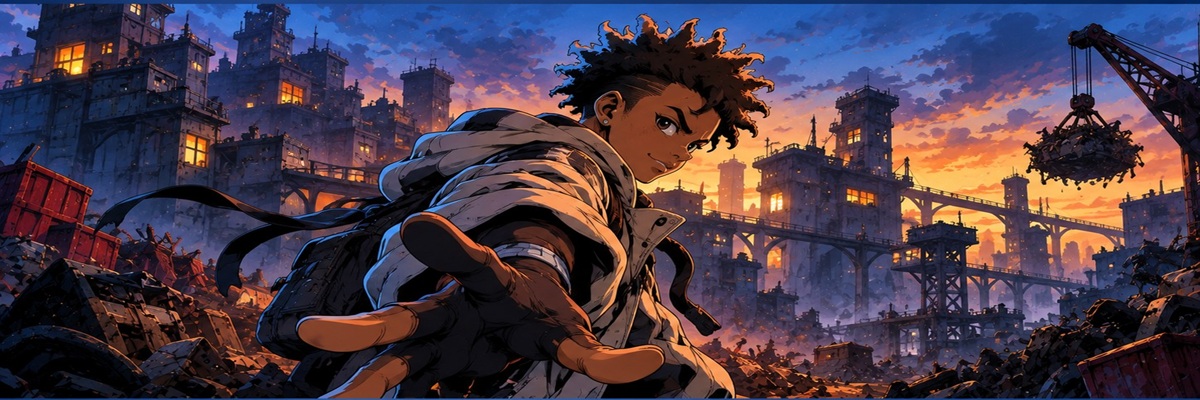
Zeno Robinson has built an extensive voice acting career through characters including Hawks in My Hero Academia, Genya Shinazugawa in Demon Slayer and Hunter in The Owl House. But his performance as Jabber Wonger in the English dub of Gachiakuta has given him an opportunity to contribute something particularly personal to a character.
In a recent interview, Robinson reflected on the creative freedom involved in developing Jabber’s English voice, including his contribution to a memorable rap that became much more than translated dialogue. He also discussed what it meant to voice a Black anime character whose design and personality allowed him to incorporate cultural influences he immediately recognized.
The role fits naturally with Robinson’s highly physical approach to voice acting, something he has discussed separately when describing just how animated he can become inside a recording booth. Together, those insights reveal how Robinson approaches dubbing as character performance rather than simply replacing dialogue from another language.
For Jabber, that approach has resulted in a performance that Robinson has been able to watch travel beyond the booth and become part of how English-speaking fans interact with the character.
Finding Jabber’s Personality in the English Dub
Based on Kei Urana’s manga, Gachiakuta follows Rudo, a young man living in the slums of a floating society where criminals and unwanted objects are discarded into a massive wasteland known as the Pit. After being falsely accused of murder and thrown into the world below, Rudo encounters the Cleaners, fighters who confront the dangerous creatures created from humanity’s discarded trash.
Jabber belongs to the Raiders, putting him on the opposing side of that conflict. His unpredictable personality, enthusiasm for fighting and distinctive appearance immediately make him one of the series’ more unusual characters.
Robinson said seeing Jabber in the manga made an immediate impression on him. The character read as Black to him, and he recognized cultural influences within both Jabber and the wider visual world of Gachiakuta. That became something he wanted to preserve rather than smooth away when constructing the English performance.
The clearest example came through Jabber’s rap. Robinson was heavily involved in adapting the sequence for the English version, helping develop lyrics and delivery that worked naturally for the character rather than treating the scene as a literal translation exercise.
For Robinson, that meant thinking about how Jabber would actually express himself in English. The character’s confidence, aggression and playfulness all needed to survive the transition, while the rhythm had to function as a performance in its own right.
It is an example of how localization can involve considerably more creative collaboration than audiences may realize. The Japanese performance provides the character and intent, but an English-language sequence built around rhythm, wordplay and cultural expression cannot always be transferred line by line. The adaptation has to produce something that creates a comparable effect for another audience.
In Jabber’s case, Robinson became part of that process.
Getting Animated Inside the Recording Booth
The energy heard in Jabber also reflects how Robinson physically approaches voice performance.
In an earlier interview about his career, Robinson described himself as extremely animated while recording. He doesn’t simply stand still at a microphone and produce the required lines. His face and body can move with the character as he works through a scene, effectively acting out elements of the performance even though none of those movements will appear on screen.
That physicality can be particularly useful with a character like Jabber. His personality rarely feels contained. He enjoys provoking people, throws himself enthusiastically into confrontations and can move rapidly between threatening and playful behavior.
Robinson’s approach illustrates an important part of animation performance that audiences never see. A finished animated character may consist entirely of drawings and a recorded voice, but the performance creating that voice can still involve many of the same physical instincts used in on-camera acting.
The physical choices do not necessarily translate literally. Instead, movement can affect breathing, timing, intensity and the way a line naturally emerges. An actor leaning into a confrontation or reacting physically to another character can produce a different vocal result from someone concentrating exclusively on the words.
Robinson’s career also demonstrates that this energy doesn’t lead to identical performances. Hawks in My Hero Academia carries an easy confidence that can conceal the seriousness underneath him. Genya in Demon Slayer is considerably rougher and more volatile, while Hunter in The Owl House gave Robinson a character whose emotional vulnerability became increasingly important as the story developed.
His anime credits have continued expanding as well, including Hajime Kashimo in Jujutsu Kaisen. Jabber adds another personality to that range, but one Robinson has been able to shape through cultural and linguistic choices particular to the English adaptation.
Seeing Fans Embrace Something He Helped Create
One of the most meaningful moments surrounding Robinson’s Gachiakuta performance happened far away from the production itself.
Robinson recently encountered footage from Katsucon showing fans dressed as Jabber and performing the English rap together. Seeing a piece of the performance he had helped create repeated collectively by fans proved emotional, particularly because he could see Black fans embracing the character and the material.
The moment demonstrated how quickly localization choices can become attached to the way an international audience understands a character. The rap wasn’t simply something Robinson recorded and left behind when the session ended. Fans learned it, repeated it and incorporated it into their own celebration of Jabber.
That response was particularly significant because Robinson has spoken openly over the years about representation within voice acting and anime dubbing.
Earlier in his career, he discussed the barriers Black performers encountered when trying to enter parts of the industry, as well as racist reactions that could accompany casting decisions. In his more recent reflections, Robinson acknowledged that representation in dubbing has improved, with more performers of color receiving opportunities than when he was establishing himself.
At the same time, he has been careful not to suggest that every problem has disappeared. The animation industry has faced broader production contractions, creating additional pressure in a field where opportunities were already competitive.
Jabber therefore represents something more specific than simply casting a Black performer in a popular anime. Robinson saw aspects of Black identity and cultural influence within the character himself, and the English production gave him room to incorporate those observations into the performance.
The fan response to the rap offered tangible evidence that those choices connected with part of the audience.
From Anime Fan to a Familiar Voice in English Dubs
Robinson’s relationship with anime began long before he was appearing in its credits.
He grew up as a fan of the medium, making his eventual career as an anime dubbing actor a transition from watching these stories to becoming one of the performers responsible for introducing characters to English-speaking audiences.
His career now reaches considerably beyond anime. Robinson has voiced Cyborg in DC animation and Hunter in Disney’s The Owl House, alongside roles across video games and other animated productions. Within anime, however, performances including Hawks, Genya, Kashimo and Jabber have made him a familiar presence across several major franchises.
That experience also gives Robinson an interesting position within the continuing evolution of English dubbing. Modern anime audiences have unprecedented access to original Japanese performances, subtitles and dubbed versions, often within hours of one another. English performers are therefore working for audiences who can easily compare interpretations while also expecting the dub to sound natural on its own terms.
Jabber shows what can happen when that process leaves room for the English performer to contribute rather than simply reproduce.
Robinson didn’t create Jabber, and the fundamental character comes from Urana’s manga and the anime adaptation built from it. But his English performance adds another layer to how that character reaches a particular audience. His physical performance style shapes the energy, his interpretation informs the personality, and his contribution to the rap helped create something specific to the English version.
The clearest measure of that contribution may ultimately be the Katsucon footage Robinson encountered.
Something that began as a localization problem inside a recording booth had become a performance fans knew well enough to recreate together. For Robinson, seeing those fans embrace Jabber also reflected a much longer journey, from growing up with anime to helping shape how one of its characters sounds to a new generation of English-speaking viewers.
