
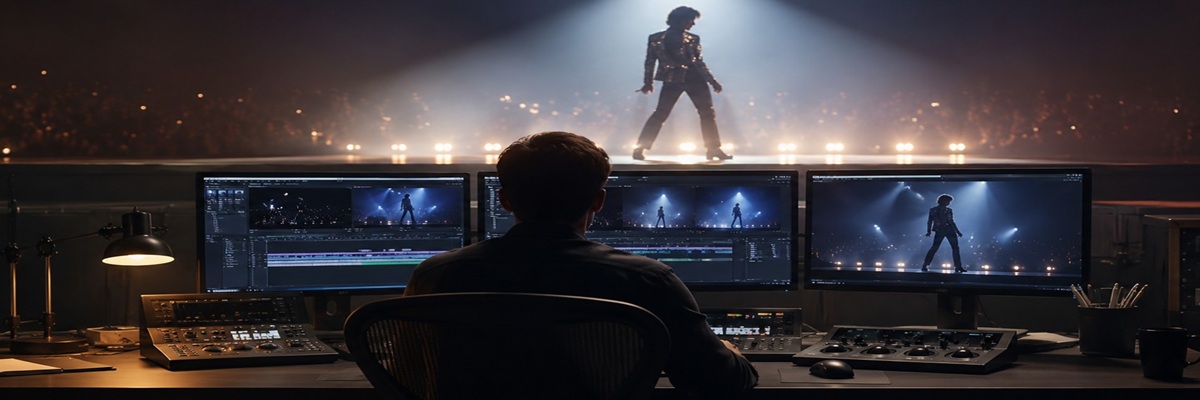
Long before Michael reached theaters, the film’s creative team faced an unexpected challenge. An early assembly reportedly ran close to four hours, forcing director Antoine Fuqua, producer Graham King, and editor Jamie Kirkpatrick to rethink how to tell the life story of one of music’s biggest icons without losing its emotional impact.
In interviews released ahead of the film’s debut, Kirkpatrick explained that the lengthy early cut was never intended to be the version audiences would see. Instead, it represented the starting point of an extensive editing process that focused on finding the emotional core of Michael Jackson’s journey rather than attempting to include every major event from his life.
For VoiceOverNews readers, the discussion goes beyond runtime. The decisions made in the editing room also affected how musical performances, dialogue, and vocal authenticity were presented, particularly with Jaafar Jackson portraying his uncle while the production carefully balanced new performances with Michael Jackson’s original recordings.
Editing a Life Into One Film
Jamie Kirkpatrick described the first assembly of Michael as running nearly four hours, giving the filmmakers an enormous amount of material to shape. Rather than trimming scenes simply to reach a commercial runtime, the editing team worked closely with Antoine Fuqua to determine which moments best communicated Michael Jackson’s personal and artistic journey.
According to Kirkpatrick, the goal became creating a film driven by emotion instead of chronology. Michael Jackson’s career stretched across decades, from his childhood with the Jackson 5 through his rise as one of the world’s biggest entertainers. Attempting to recreate every milestone would have produced a film that felt more like a timeline than a dramatic story.
Producer Graham King echoed that approach, explaining that the production focused on finding the strongest narrative rather than documenting every chapter of Jackson’s life. As scenes were removed and sequences tightened, the emphasis shifted toward the relationships, performances, and defining moments that best reflected the film’s central themes.
The extensive edit also arrived alongside other production changes before the film’s release, including revisions to the script and additional photography. Those developments made post-production one of the most significant phases of the project as the filmmakers refined the story audiences would ultimately see.
Recreating an Iconic Voice
While the editing process shaped the story, another major creative decision centered on the film’s musical performances.
One of the biggest questions surrounding Michael before release was whether Jaafar Jackson would sing the songs himself. The answer turned out to be more nuanced than many expected. The filmmakers confirmed that Jaafar performs many vocal moments, while Michael Jackson’s original recordings are also used throughout the film. In some sequences, the production blends the two voices to preserve the authenticity of the original performances while allowing Jaafar’s acting and physical portrayal to remain seamless.
That hybrid approach reflects the unique challenge of portraying one of the most recognizable voices in music history. Unlike many musical biopics that rely entirely on either lip-syncing or newly recorded vocals, Michael uses different techniques depending on what best serves each scene. The result is intended to maintain the emotional connection audiences have with Michael Jackson’s recordings while still showcasing Jaafar Jackson’s performance.
For voice professionals, the production offers an interesting example of how modern films can combine live acting, archival recordings, and careful audio editing to recreate an iconic performer without relying on a single solution.
Why the Editing and Voice Work Matter Together
The conversations surrounding Michael before its release showed that editing and voice performance were closely connected creative decisions rather than separate production challenges.
Reducing a nearly four-hour assembly meant every remaining musical sequence needed to carry greater dramatic weight. Each performance had to advance the story while also honoring the legacy of an artist whose voice remains instantly recognizable around the world. That placed additional importance on the choices made in both the editing room and the sound department.
Whether audiences focused on Jaafar Jackson’s performance, the recreated concert sequences, or the blend of original vocals with newly filmed material, the filmmakers approached the project with the understanding that authenticity extended beyond visual resemblance. It also depended on preserving the emotional impact of Michael Jackson’s voice.
As Michael prepared for its theatrical release, the discussions around its lengthy early cut and its carefully crafted vocal performances offered a rare look at the creative decisions required to bring one of music’s most recognizable artists to the screen. For voice actors and film professionals alike, it serves as a reminder that editing, performance, and sound often work together to shape the story audiences ultimately experience.
