
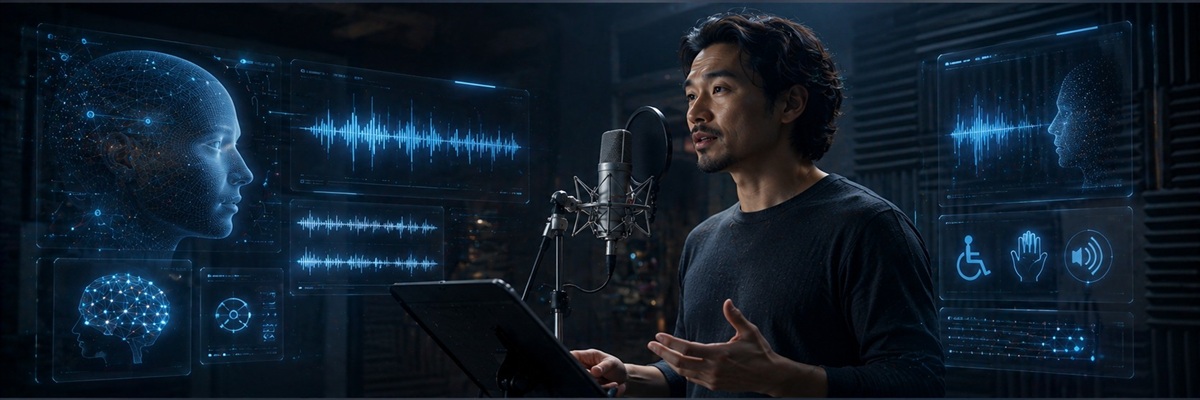
Apple’s latest accessibility announcements were widely praised for expanding tools that help users navigate technology more naturally. The company introduced updates tied to Voice Control, VoiceOver, Accessibility Reader, Magnifier, and other systems powered in part by Apple Intelligence. Many of these features rely on more advanced speech interaction, contextual awareness, and AI-assisted communication.
For accessibility advocates, the rollout represents meaningful progress. For voice actors, however, the news also arrives with familiar concerns about where synthetic speech technology is heading next.
To be clear, Apple’s new features are not designed to replace animated performances, commercial narration, or dramatic acting work. The company is positioning the tools as assistive technologies focused on usability and communication. Even so, many performers are watching developments like this closely because they reflect a broader shift toward normalized machine-generated speech across everyday consumer experiences.
The concern is not necessarily about this specific update. It is about the direction the industry may be moving over time.
Accessibility AI and Entertainment Voice Acting Are Different, But the Lines Can Shift
One of the most important distinctions in Apple’s rollout is the difference between functional speech systems and performance-based voice acting.
Accessibility tools prioritize clarity, navigation, and responsiveness. They are built to help users read information, interpret surroundings, issue commands, and interact with devices more efficiently. These systems are optimized for utility.
Voice acting depends on something entirely different.
Character work, commercial narration, audiobooks, cinematic trailers, and interactive game performances require emotional interpretation, acting instinct, timing, and creative collaboration. Those elements remain difficult for synthetic systems to reproduce convincingly at a professional level.
That distinction is why many voice actors are not reacting to Apple’s announcement with immediate panic. Most understand that a screen reader voice is not competing directly with a dramatic performance in a major video game or animated film.
The larger concern is that technology ecosystems evolve gradually.
Voice actors have already watched synthetic speech improve significantly over the past decade. Digital assistants that once sounded robotic are now far more conversational. Customer service systems increasingly rely on natural-sounding AI voices. Translation tools, audiobook experiments, and automated narration systems continue improving every year.
Each individual advancement may appear limited on its own. Combined together, however, they contribute to a growing normalization of synthetic speech across media and communication.
That cultural normalization is what many performers are paying attention to.
As consumers become more comfortable hearing AI-generated voices in daily life, companies may become more willing to experiment with replacing human narration in lower-budget productions, internal training materials, educational content, and utility-focused voice projects.
Apple’s accessibility rollout is not directly causing that shift, but it exists within the same technological ecosystem.
Voice Actors Continue Asking for Clear Ethical Boundaries
The discussion surrounding AI speech technology is no longer limited to whether synthetic voices can sound realistic. Increasingly, the debate centers on consent, ownership, compensation, and performer protections.
Many actors remain concerned about how voice data is collected, trained, licensed, and reused. Some fear a future where performances are replicated without adequate approval or fair compensation. Others worry that widespread acceptance of AI speech systems may slowly reduce opportunities in parts of the industry that prioritize efficiency over artistry.
These concerns have already surfaced across several entertainment sectors.
Audiobook narration has become a particularly active battleground as publishers experiment with synthetic narration tools. Video game performers have also voiced concerns about digital replication and AI-assisted performance systems. SAG-AFTRA and other industry groups continue discussing protections tied to synthetic reproduction and digital performance rights.
Against that backdrop, announcements from major technology companies inevitably attract attention from performers, even when the tools themselves are accessibility-focused.
Apple’s approach differs from some startups that aggressively market AI-generated voices as replacements for actors. The company continues emphasizing privacy, assistive functionality, and on-device processing rather than synthetic entertainment performance.
That distinction matters because Apple is not currently presenting these tools as substitutes for professional creative work.
At the same time, major companies often influence broader market expectations. When consumers become accustomed to increasingly natural AI speech systems from trusted brands, the overall perception of machine-generated voices can shift quickly.
Voice actors are not simply reacting to a single software update. They are reacting to a long-term pattern of technological acceleration that continues reshaping audio production across multiple industries.
Human Performance Still Holds an Advantage That Technology Has Not Replicated
Despite growing concern around synthetic speech, many professionals within the voiceover industry still believe human performance remains fundamentally different from machine-generated communication.
The strongest performances often rely on emotional unpredictability, improvisation, vulnerability, and subtle interpretation. Actors adjust pacing instinctively. They respond to direction in real time. They shape performances around context, tone, and audience expectation.
Synthetic systems can imitate speech patterns, but imitation is not the same as interpretation.
That difference becomes particularly obvious in emotionally demanding performances. Animated characters, dramatic storytelling, comedic timing, emotionally layered game performances, and long-form narration still rely heavily on human instinct and creative decision-making.
Ironically, the rapid growth of AI voices may actually make audiences more aware of what human performers contribute.
As synthetic voices become increasingly common in navigation systems, automated summaries, and accessibility tools, listeners may start recognizing the contrast between informational speech and emotionally driven performance more clearly than before.
Many consumers already instinctively distinguish between a voice that provides instructions and a voice that tells a story.
That distinction may ultimately protect large portions of the entertainment voiceover industry even as AI speech technology becomes more advanced.
The future of voice acting will likely involve continued adaptation. Some lower-budget or utility-focused projects may shift toward automation. New legal and ethical standards will almost certainly emerge around digital voice rights. Accessibility tools powered by AI will continue expanding rapidly.
Yet Apple’s latest accessibility push also reinforces an important reality that many performers continue emphasizing.
Generating speech is not the same thing as delivering a performance.
For now, the emotional connection audiences form with human voices still depends on qualities that technology has not fully replicated.
