
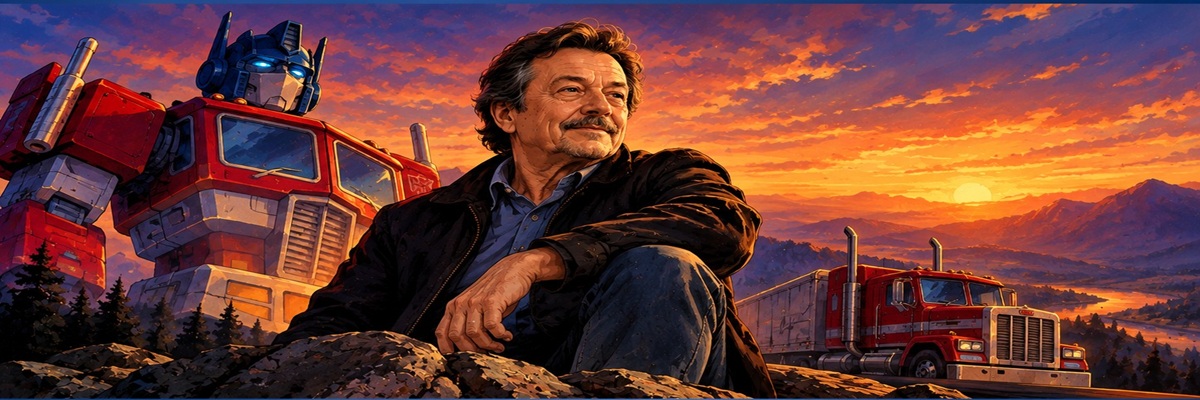
Peter Cullen, the prolific voice actor whose commanding performance as Optimus Prime became one of the most recognizable voices in animation, died on August 26 at his home in Los Angeles. He was 85.
Cullen’s agent, Kevin Motley, confirmed that the actor died peacefully surrounded by his family. No cause of death was announced. His family asked that those wishing to honor him do so by serving their communities and leading with compassion, integrity and loyalty, while remembering a phrase that had followed Cullen throughout much of his career: “be strong enough to be gentle.”
That phrase is inseparable from the story of Optimus Prime, but Cullen’s career extended far beyond the leader of the Autobots. Over six decades, he accumulated more than 200 credits across animation, movies, television, video games and theme park attractions. He was also the gentle, perpetually gloomy Eeyore in numerous Winnie the Pooh productions, performed the vocal effects of the Predator, played KARR in Knight Rider and appeared across franchises including G.I. Joe, The Smurfs, Chip ‘n Dale: Rescue Rangers and Invincible.
Yet Optimus Prime became something different. Cullen didn’t simply voice the character in a successful 1980s cartoon. He helped establish the qualities audiences would associate with Optimus for more than four decades, and he did it by drawing inspiration from the person he considered a real hero: his older brother Larry.
From Montreal to a Career Behind the Microphone
Peter Claver Cullen was born in Montreal, Quebec, on July 28, 1941. His interest in voices appeared long before he entered a recording studio. Cullen later recalled experimenting with accents and speeches as a child while working around a neighboring dairy farm, discovering that even the cows would react when he changed the way he sounded.
A high school teacher recognized his vocal abilities and encouraged his interest in performance. Cullen eventually attended the National Theatre School of Canada, graduating as part of its first graduating class in 1963.
His early career was considerably more visible than the work for which he would eventually become famous. He performed on Canadian television and later worked as an announcer on The Smothers Brothers Comedy Hour, while also appearing in comedy material connected with Sonny & Cher. As his career developed, however, Cullen increasingly found a home behind the microphone.
Animation provided steady work through productions including The Smurfs and G.I. Joe, but Cullen’s vocal talents weren’t limited to conventional speaking roles. For the 1976 remake of King Kong, he contributed vocalizations for the title creature. A decade later, he helped give the alien hunter in Predator its distinctive clicks and other vocal effects.
By the early 1980s, Cullen was already a seasoned voiceover artist accustomed to the unusual audition descriptions that came with animation. Then, in 1984, he was asked to audition for a heroic transforming truck.
It sounded like another strange voiceover assignment. Instead, it became the role of his life.
How Peter Cullen Found the Voice of Optimus Prime
Before auditioning for Transformers, Cullen spoke with his older brother Larry Cullen about the character. Larry had served as a Marine officer in Vietnam, and Peter regarded him as his personal example of what genuine heroism looked like.
Larry’s advice would become fundamental to Optimus Prime.
Rather than playing the character like a stereotypical action hero, Larry encouraged his brother to make him compassionate and truthful. Most importantly, he told Peter that a real hero should be “strong enough to be gentle.”
Cullen went into the audition with Larry in mind. He lowered himself into the calm, authoritative delivery that would become Optimus Prime and effectively modeled the Autobot leader’s character on his brother’s personality. Cullen later described his performance as an impression of Larry, saying that every time he returned to Optimus, he could still feel his brother’s presence in the voice.
The result was very different from the shouting bravado that might have been expected from the leader of a team of giant transforming robots. Cullen’s Optimus rarely needed to sound desperate to establish authority. His deliberate pacing and deep baritone made the character feel powerful, but there was almost always restraint underneath that power.
That distinction became essential to Optimus Prime. He was a warrior when necessary, but leadership was expressed through responsibility, sacrifice and compassion rather than aggression.
Cullen first voiced Optimus in the original Transformers animated series in 1984 and continued into The Transformers: The Movie in 1986. The film’s decision to kill Optimus became one of the most infamous moments in the franchise, particularly among the young audience that had grown attached to the character. Cullen himself later spoke about the emotional impact of the decision.
The character eventually returned, and decades later so did Cullen.
When Michael Bay’s live-action Transformers arrived in 2007, Cullen was brought back as Optimus Prime. His presence created an immediate connection between the new film and the animated series that had introduced the character more than 20 years earlier.
He continued voicing Optimus through multiple live-action movies, animated productions and video games, ultimately carrying the performance across generations of Transformers storytelling. Designs changed, continuities restarted and new audiences arrived, but Cullen’s voice remained the sound many fans instinctively associated with Optimus Prime.
Eeyore Revealed a Completely Different Side of His Voice
If Optimus Prime demonstrated Cullen’s authority, Eeyore demonstrated just how misleading it would be to define his abilities solely through his powerful natural baritone.
Cullen began voicing Eeyore in Disney’s Winnie the Pooh productions in the late 1980s, succeeding earlier performers who had played the famously pessimistic donkey. He continued with the character across television series, films, specials and games for decades.
The contrast between Cullen’s two signature roles was remarkable. Optimus carried the responsibility of entire worlds in his voice. Eeyore sounded as though getting through an ordinary afternoon might require considerable effort.
Cullen softened his delivery and slowed the character’s rhythms, giving Eeyore a weary melancholy without losing the warmth that made him lovable. The humor rarely came from pushing for a joke. Instead, it emerged from Eeyore’s understated acceptance that something had probably gone wrong again.
Cullen frequently identified Eeyore as one of his favorite roles after Optimus. The character also provided a different kind of connection with young audiences. Children who had never watched Transformers could still recognize the gloomy donkey from the Hundred Acre Wood, often without realizing the same performer was responsible for both voices.
The two characters became an extraordinary demonstration of Cullen’s range. One inspired audiences through strength and leadership. The other became beloved through vulnerability, resignation and quiet kindness.
Peter Cullen’s Voice Reached Far Beyond Two Famous Characters
Optimus Prime and Eeyore could have defined an entire career, but Cullen’s body of work was considerably larger.
He voiced Monterey Jack in Chip ‘n Dale: Rescue Rangers and appeared in multiple G.I. Joe productions. His animation credits also stretched across series including The Smurfs, Voltron and numerous other television projects during an era when voice actors often moved rapidly between several productions.
Cullen also provided the voice of KARR, the dangerous counterpart to KITT in Knight Rider. The role demonstrated how effectively his voice could transform a machine into a character even without a visible human performance, something that would become particularly fitting given his association with Transformers.
His creature work showed another specialized side of voice acting. On Predator, Cullen contributed the alien’s clicks and trills, helping create a vocal identity for a creature whose menace depended as much on sound as dialogue. The resulting noises became instantly associated with the Predator and remained part of one of science fiction cinema’s most recognizable monsters.
Decades later, Cullen continued appearing in contemporary animation. He voiced Thaedus in Invincible, introducing his voice to another generation through a very different kind of superhero series. His presence in the show underscored the longevity of a career that had begun professionally in the 1960s.
The breadth of those roles is important because Cullen’s fame could sometimes make Optimus Prime appear to be the entirety of his career. In reality, he belonged to a generation of highly versatile voice performers capable of moving between heroes, villains, animals, machines and creatures, sometimes without audiences realizing they were hearing the same actor.
Optimus Prime Became Bigger Than an Ordinary Voice Role
The unusual longevity of Cullen’s relationship with Optimus also changed his relationship with Transformers fans.
Many animated characters are voiced by multiple performers as franchises are rebooted and reinterpreted. Optimus Prime certainly had other actors over the years, but Cullen remained the benchmark against which many portrayals were measured.
His return in the 2007 film reinforced that relationship. Adults who had watched the original cartoon could take their own children to a completely new version of Transformers and hear the same voice leading the Autobots.
Cullen embraced that connection through convention appearances and interactions with fans, where requests to perform Optimus lines became inevitable. What had begun as an audition for a children’s animated series had developed into a role people associated with their childhoods, their ideas about leadership and, in some cases, lessons they had carried into adulthood.
The industry formally recognized Cullen’s contribution in 2023 when he received the Lifetime Achievement Award at the Children’s & Family Emmy Awards. By then, his career represented far more than longevity. He had become one of the clearest examples of how a voice performance created for children’s entertainment could remain culturally meaningful across several generations.
Hasbro’s tribute following his death emphasized that impact, remembering Cullen not only for giving Optimus his voice but for shaping how millions of people understood the character’s courage, sacrifice and leadership.
The company also described Cullen himself in terms remarkably similar to those associated with Optimus: warmth, humility and quiet strength.
Be Strong Enough to Be Gentle
There is something particularly fitting about the fact that Peter Cullen’s most famous performance began with advice from someone else.
He didn’t approach Optimus Prime by asking how a giant robot should sound. He asked what a genuine hero should sound like, and his brother Larry gave him the answer.
More than 40 years later, the distinction remains audible in the performance. Optimus could command armies and confront enormous threats, but Cullen gave him a fundamental gentleness that prevented authority from becoming intimidation. The character sounded powerful because he didn’t constantly need to prove that he was powerful.
That philosophy ultimately extended beyond Optimus.
Following Cullen’s death, his family asked fans to remember him through compassion, integrity, loyalty and service to others. Their message ended with the same principle Larry Cullen had shared before that transformative audition: be strong enough to be gentle.
Peter Cullen spent more than six decades using his voice to create characters. Some were heroic, some melancholy, some mechanical and some barely used words at all. His work could be heard in Saturday morning cartoons, Disney stories, blockbuster movies, video games and some of popular culture’s most recognizable creatures.
But one voice rose above all the others.
Cullen borrowed its humanity from the brother he admired, carried it into a recording studio in 1984 and spent the next four decades sharing it with generations of listeners. Optimus Prime may have been a fictional hero, but the qualities Peter Cullen placed inside that voice were very real.
