
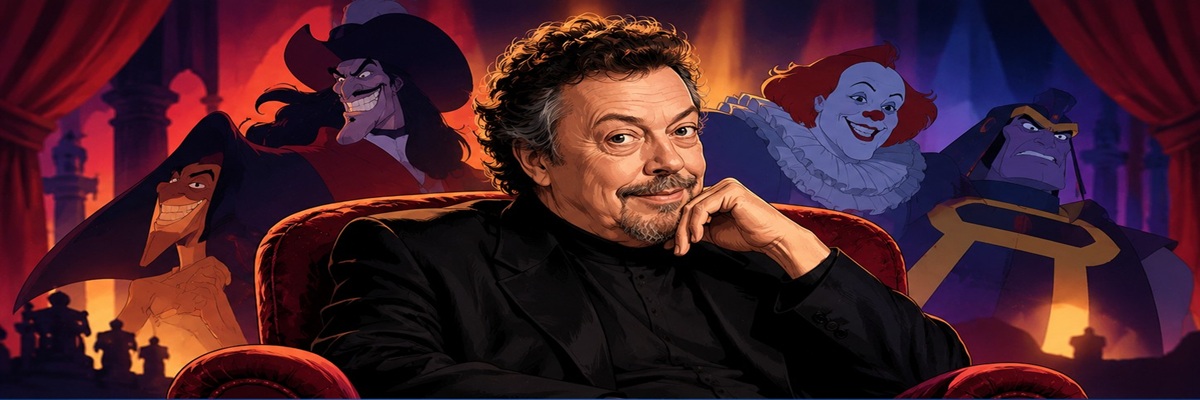
Tim Curry, the unmistakable performer whose career stretched from the stage phenomenon of The Rocky Horror Show to some of animation’s most memorable villains and eccentrics, died on August 25 at his home in Los Angeles. He was 80.
For many audiences, Curry will always be Dr. Frank-N-Furter, the role he originated onstage before carrying it into the 1975 cult classic The Rocky Horror Picture Show. Others remember the unnerving Pennywise of Stephen King’s It, the frantic Wadsworth of Clue, Darkness in Legend or Long John Silver in Muppet Treasure Island. Yet there is another generation for whom Curry’s face was almost beside the point. They knew him first as Nigel Thornberry, Captain Hook, Hexxus, Professor Calamitous or one of the many other animated characters he created during an extraordinarily prolific voice acting career.
That ability to move between mediums became one of Curry’s defining qualities. He could command a theater, dominate a movie scene, record an album, narrate a book and disappear into an animated character without treating any of those disciplines as secondary. Even after a major stroke transformed his life in 2012, his voice remained an important connection to performing.
His death closes a career that lasted more than five decades, but Curry’s influence is unusually difficult to confine to one part of entertainment history. He belonged simultaneously to musical theater, cult cinema, comedy, horror, animation and voiceover, with different generations discovering him through entirely different characters.
From the Stage to a Career That Defied Categories
Timothy James Curry was born in Grappenhall, Cheshire, England, on April 19, 1946. He eventually studied English and Drama at the University of Birmingham before beginning his professional stage career in the original London production of Hair in 1968.
His defining early breakthrough came several years later when he originated Dr. Frank-N-Furter in Richard O’Brien’s The Rocky Horror Show in 1973. Curry carried the performance to Los Angeles and Broadway before reprising the character in The Rocky Horror Picture Show. The film was initially unsuccessful but gradually developed into one of cinema’s most enduring cult phenomena through midnight screenings and an unusually participatory fan culture.
Frank-N-Furter demonstrated qualities that would repeatedly surface throughout Curry’s career. He was fearless about exaggeration, but the exaggeration was controlled. His characters could be flamboyant, menacing, absurd and funny within the same performance. Rather than backing away from theatricality for the camera, Curry learned how to make theatricality itself part of his screen presence.
Hollywood subsequently found many different uses for that ability. He played Rooster Hannigan in Annie, the enormous horned Darkness in Ridley Scott’s Legend, and Wadsworth, the increasingly frantic butler at the center of Clue. In 1990, he delivered one of his most famous performances as Pennywise in the television adaptation of Stephen King’s It, creating a version of the character that terrified viewers long before the story returned to the screen decades later.
His film career also included Cardinal Richelieu in The Three Musketeers, the suspicious concierge Mr. Hector in Home Alone 2: Lost in New York and Long John Silver in Muppet Treasure Island. The roles could hardly have been more different, yet Curry’s ability to make unusual characters immediately memorable connected them.
Theater remained equally important. His Broadway work earned three Tony Award nominations, for Amadeus, My Favorite Year and Monty Python’s Spamalot. He also maintained a music career, releasing the albums Read My Lips, Fearless and Simplicity between 1978 and 1981.
Long before animation became a major component of his career, Curry had therefore spent years developing one of his most valuable tools. His voice could shift from sophisticated to grotesque, seductive to threatening and restrained to completely unhinged. Voice acting eventually gave him an entire medium in which to explore that range.
Tim Curry Built Another Career Behind the Microphone
Curry’s voice credits became extensive enough to represent a major career of their own. Beginning in the late 1980s and accelerating throughout the 1990s and 2000s, he appeared across animated television, feature films, video games and other voice projects.
One of his earliest major successes came as Captain Hook in Fox’s Peter Pan and the Pirates. Curry approached Hook with the theatrical authority that suited the character but gave him enough comic personality to prevent the villain from becoming one-dimensional. The performance earned Curry a Daytime Emmy Award for Outstanding Performer in a Children’s Series in 1991.
The following year brought another of his best-known animated villains. In FernGully: The Last Rainforest, Curry voiced Hexxus, the malevolent embodiment of pollution released from imprisonment inside a tree. Hexxus gave Curry the opportunity to combine character acting with music, most memorably through the villain’s songs, while making a largely amorphous animated presence feel dangerously charismatic.
His animation work continued almost constantly. Curry voiced Dr. Anton Sevarius in Gargoyles, MAL in Captain Planet and the Planeteers, Slagar the Cruel in Redwall and Professor Calamitous in the Jimmy Neutron franchise. He appeared in Duckman, The Little Mermaid television series, The Mask, Superman: The Animated Series, Batman Beyond, Young Justice and numerous other productions.
Yet Nigel Thornberry became something different.
Curry voiced the eccentric wildlife documentarian throughout Nickelodeon’s The Wild Thornberrys, which premiered in 1998. Nigel’s enormous enthusiasm, exaggerated pronunciation and almost complete absence of self-consciousness made the character instantly recognizable. Curry also carried the performance into The Wild Thornberrys Movie and Rugrats Go Wild.
For children growing up around the turn of the millennium, Nigel could easily have been their introduction to Curry. Years later, the character found another audience online, where Nigel’s distinctive appearance and Curry’s delivery became fixtures of meme culture. It was an unexpected second life for a performance created for a children’s animated series, but it demonstrated how deeply Curry’s vocal choices had lodged themselves in popular culture.
What distinguished many of these performances was that Curry rarely seemed interested in simply supplying his recognizable speaking voice. Hexxus had a smooth, poisonous seductiveness. Nigel Thornberry exploded with cheerful enthusiasm. Captain Hook carried wounded aristocratic pride. Professor Calamitous embraced cartoonish supervillain absurdity. Curry remained identifiable, but the personalities surrounding that voice changed dramatically.
His later animation work included another memorable performance as Auntie Whispers in Cartoon Network’s Over the Garden Wall. Curry’s presence fit naturally into the miniseries’ mixture of fairy-tale warmth and unsettling darkness, giving him yet another character that reached viewers decades after his first animated roles.
The Joker Became One of Voice Acting’s Great What-If Stories
Among Curry’s many voice credits is one famous performance audiences were never originally supposed to miss.
Before Mark Hamill became synonymous with the Joker in Batman: The Animated Series, Curry had been cast as the character and recorded several episodes. Animation work had progressed using his performances before the production ultimately recast the role.
Different explanations circulated for years about why Curry was replaced. One frequently repeated story suggested that his interpretation had simply been too frightening. Curry himself later offered a much more straightforward account, saying that he had developed bronchitis and was fired.
Whatever combination of circumstances led to the change, Curry had recorded enough material that Hamill faced an unusual challenge when taking over. Rather than beginning every episode with a clean slate, some animation had already been timed around Curry’s dialogue.
Hamill later recalled that during those early replacement sessions he recorded alone and had to dub lines against mouth movements created for another actor’s timing. Curry’s approach was different from the voice Hamill was developing, meaning Hamill had to establish his own interpretation while working within physical animation created around Curry’s performance.
Hamill, of course, went on to create one of the most celebrated portrayals in the history of superhero animation. His Joker became a defining part of Batman: The Animated Series and a role he would revisit across television, movies and video games.
Curry’s involvement remains a fascinating alternate path in animation history, but it is only a footnote within his much larger voice career. He did not need the Joker to establish himself as a major voice performer. By the time audiences were hearing Nigel Thornberry a few years later, Curry was creating a completely different character who would become iconic in his own right.
From Video Games to Audiobook Narration
Curry’s voice career extended well beyond television animation. Video games offered another outlet, particularly as games increasingly began casting established actors in substantial character roles.
His credits included Gabriel Knight in Gabriel Knight: Sins of the Fathers and its later entries, Premier Cherdenko in Command & Conquer: Red Alert 3 and Arl Howe in Dragon Age: Origins. He also voiced characters in games connected to franchises including Scooby-Doo, The Wild Thornberrys and Lemony Snicket’s A Series of Unfortunate Events.
Curry’s audiobook work showed another side of his vocal abilities. Where an animated villain might allow several minutes of heightened character work at a time, audiobook narration required sustained storytelling, pacing and differentiation between multiple characters across hours of material.
He became particularly associated with the audio editions of A Series of Unfortunate Events. His narration of Lemony Snicket’s darkly comic world was well suited to a performer who had spent decades moving comfortably between menace and humor. His audiobook work earned him a Grammy nomination, adding another form of recognition to a career already decorated across stage and television.
These projects reinforced the extent to which Curry’s voice had become independently valuable. By the 1990s and 2000s, audiences did not necessarily need to see him for a production to make use of everything that made a Tim Curry performance distinctive.
The Performer Other Actors Never Forgot
Following Curry’s death, tributes came from across an entertainment industry in which he had worked for more than half a century. They reflected not only affection for famous characters but respect for a performer whose career had become a reference point for other actors.
Curry’s influence was partly a consequence of his refusal to be contained by conventional ideas about what a leading performer should be. He could play a glamorous musical provocateur, a terrifying clown, a cartoon wildlife presenter or a theatrical supervillain without approaching one as inherently more respectable than another.
That willingness to commit fully to unusual material was particularly important to the generations of actors and voice performers who followed him. Curry demonstrated that broad performances did not have to be careless performances. His villains could be enormous because the choices beneath them were precise.
His reputation among collaborators also extended beyond the characters audiences saw and heard. Colleagues remembering him after his death described an intelligent, funny and generous performer, while his longevity meant he worked alongside several generations of actors across theater, film, television and animation.
Rather than functioning as a formal mentor in the conventional sense, Curry became something broader: an example of how varied an acting career could be. Voice actors could look at his career and see animation existing comfortably beside Broadway. Character actors could see cult films coexist with prestige theater. Younger performers could encounter him through Nickelodeon without realizing they were listening to an actor whose professional history stretched back to the original London production of Hair.
That cross-generational quality would become particularly apparent later in Curry’s life, when conventions and fan appearances brought him face to face with people who had discovered him through entirely different parts of his career.
A Stroke Changed Curry’s Life, but Not His Connection to Audiences
Curry suffered a major stroke in July 2012. It was a profound turning point that left him with lasting physical disabilities, including paralysis on his left side, and he subsequently used a wheelchair.
He later wrote openly about the experience in his memoir Vagabond, including the emergency brain surgery and long rehabilitation that followed. Curry had to contend not only with changes to his mobility but with the effects the stroke initially had on communication and other basic parts of everyday life.
For an actor whose work had often depended on such a physical stage and screen presence, the consequences were substantial. His professional life changed, but it did not end.
Voice performance offered one avenue through which Curry could continue working. His post-stroke credits included Auntie Whispers in Over the Garden Wall, while he also took over the role of Darth Sidious in Star Wars: The Clone Wars following the death of Ian Abercrombie. Curry’s Palpatine appeared during the later stages of the series and gave him another major franchise role.
He also returned to Rocky Horror in a different capacity. In Fox’s 2016 television production The Rocky Horror Picture Show: Let’s Do the Time Warp Again, Curry appeared as the Criminologist, allowing him to participate in a new version of the story more than four decades after originating Frank-N-Furter.
Public appearances increasingly became another connection between Curry and his audience. He attended conventions and anniversary events, sometimes alongside longtime friends and fellow performers, and saw firsthand how much his work had endured. He also returned to live-action film with an appearance in the 2024 horror movie Stream.
The years after his stroke inevitably became part of Curry’s story, but they never erased everything that preceded them. If anything, they demonstrated just how many different ways he had already learned to be a performer.
Vagabond Gave Curry the Chance to Tell His Own Story
In 2025, Curry published Vagabond, a memoir that arrived as The Rocky Horror Picture Show celebrated its 50th anniversary.
The book allowed Curry to revisit a life that had moved through British theater, Broadway, Hollywood, recording studios and eventually a long and difficult recovery. He wrote about his childhood, career, relationships, health and the many unexpected turns that had shaped his life.
The memoir also arrived after years of Curry hearing directly from fans at appearances and conventions. Those encounters had made clear that his work meant very different things to different people. A fan approaching Curry might have been there because of Rocky Horror, Clue or It. Someone else might have grown up watching The Wild Thornberrys. Another might have spent hours listening to him narrate an audiobook or encountered him through a video game.
That breadth helps explain why Curry’s death has resonated across so many corners of entertainment. His career cannot easily be summarized through a single signature performance, even when that performance is as culturally significant as Frank-N-Furter.
A Voice That Belonged to Several Generations
Tim Curry spent much of his career playing characters who were difficult to ignore.
Frank-N-Furter strutted into popular culture with audacity. Pennywise turned an ordinary clown into a childhood nightmare. Wadsworth transformed mounting panic into comedy. Darkness became a towering fantasy villain. Long John Silver brought theatrical mischief to the Muppets.
His voice performances accomplished much the same thing without his physical presence.
Captain Hook gave him an Emmy-winning animated villain. Hexxus allowed menace and musicality to coexist. Nigel Thornberry turned an eccentric cartoon father into a character remembered decades later. Professor Calamitous, Auntie Whispers and his many other roles continued demonstrating how naturally Curry could adapt his theatrical instincts to animation.
It is possible for several generations to have entirely different ideas of what constitutes a classic Tim Curry performance, and all of them can be right.
That may ultimately be the most unusual aspect of his legacy. Curry did not simply remain recognizable for more than five decades. He repeatedly found new audiences without abandoning the qualities that made his performances distinctive in the first place.
His face became part of cult film history, but his voice traveled even further. For generations who heard Tim Curry long before they knew his name, those characters remain part of the remarkable career he leaves behind.
