
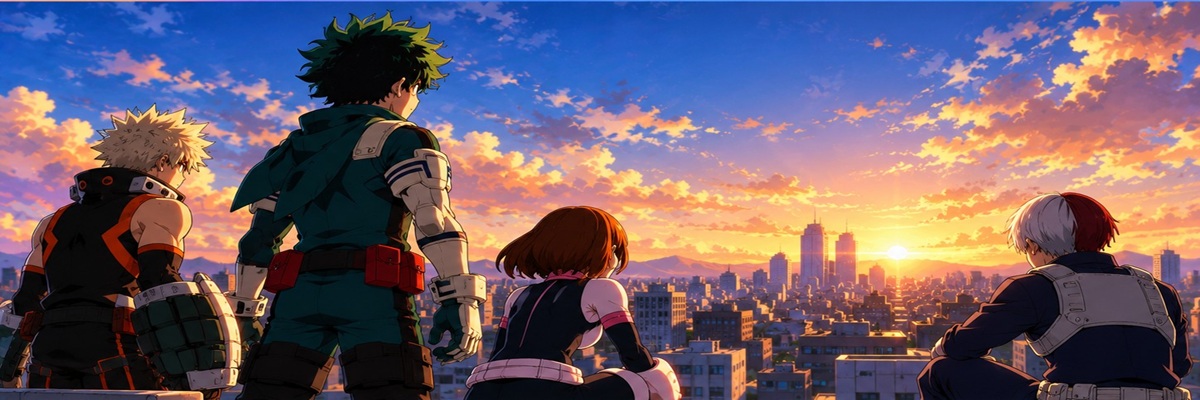
Ten years after My Hero Academia first arrived on television, four of the actors behind its English dub reunited at San Diego Comic-Con 2026 to look back at characters who became a major part of their careers.
Justin Briner, the voice of Izuku Midoriya, joined Christopher Sabat, Clifford Chapin and David Matranga for the July 23 anniversary panel in Ballroom 20. Together, the four represent some of the anime’s most recognizable characters: Deku, All Might, Katsuki Bakugo and Shoto Todoroki.
The occasion came at an appropriate point in the franchise’s history. The original anime had completed its eight-season run, including its Final Season and the subsequent “More” epilogue, leaving the actors in a position to reflect on the complete journeys of characters they had performed for nearly a decade. Rather than concentrating on another upcoming season, the Comic-Con discussion became a retrospective on what those roles had meant to the performers themselves.
A Decade With Deku, All Might, Bakugo and Todoroki
The My Hero Academia anime premiered in Japan in April 2016, with the English dub following soon afterward. Briner, Sabat, Chapin and Matranga have consequently spent much of the past decade returning to the same characters as their circumstances, relationships and personalities changed around them.
For Matranga, playing Todoroki for that length of time was an opportunity he described at Comic-Con as a dream come true. He reflected on how unusual it is for an actor to have the chance to stay with a character through such an extensive journey and described the experience as an honor.
Todoroki gave Matranga particularly complex material to follow. He begins the series as a talented but emotionally guarded student carrying the effects of his difficult family life. His relationship with Endeavor, his feelings toward his mother and siblings, and the eventual revelations surrounding Dabi gradually turn the Todoroki family into one of the anime’s most emotionally demanding storylines.
Looking back on the character, Matranga said one of the lessons he took from Todoroki was the importance of community and having supportive people around you. He also pointed to something simpler that the character’s journey had reinforced for him: a person does not have to be perfect to still be good.
For Sabat, the passage of a decade was especially apparent in the audience. He joked about how young many fans had been when the series started and how some of those same viewers had since grown up and started families of their own.
That change reflects the unusual length of the cast’s relationship with My Hero Academia. The actors weren’t simply returning to characters across a few seasons. New episodes, movies, games and other projects kept the franchise present for almost the entire period, allowing the performers and audience to experience much of its growth together.
The Characters Changed and So Did the Lessons Behind Them
Briner’s Deku perhaps provides the clearest example of how dramatically a performance could evolve across the series. The character introduced at the beginning of My Hero Academia was an anxious, Quirkless teenager who admired heroes from a distance and frequently struggled with his own confidence.
The Deku at the end of the story had experienced war, enormous responsibility and the consequences of trying to carry too much alone.
At Comic-Con, Briner focused less on Deku’s increasing physical power and more on what the character had taught him about other people. He highlighted kindness and compassion as forms of strength while also pointing to Deku’s eventual realization that asking for help is not a weakness.
That idea became increasingly important as the anime progressed. Deku repeatedly tried to shoulder responsibility himself, most dramatically when he separated from his classmates during one of the story’s darkest periods. His eventual willingness to rely on the people around him became part of his maturation as both a person and a hero.
Chapin’s experience with Bakugo followed a very different path. Bakugo began as one of the series’ most abrasive characters, with his explosive temper and treatment of Deku making him deliberately difficult to like. Over time, the story gradually exposed his insecurities and forced him to confront the consequences of his behavior.
Chapin described the effect of playing Bakugo as powerful and profound. One of the lessons he associated with the character was learning to look beyond oneself, an observation that closely mirrors Bakugo’s progression from someone intensely focused on his own strength toward someone capable of recognizing the value and sacrifices of others.
All Might’s development gave Sabat yet another perspective. He entered the story already established as the Symbol of Peace, the hero Deku and countless others wanted to emulate. Yet much of his story involved revealing the vulnerable man behind that image.
Sabat pointed directly to that vulnerability during the anniversary panel, describing emotional availability itself as a kind of superpower. It is an appropriate lesson from a character who initially maintained an almost impossibly confident public persona while concealing his injuries, fears and limitations.
Comic-Con Turned the Anniversary Into a Live Performance
The retrospective did not remain entirely conversational. After discussing what the characters had meant to them, Briner, Sabat, Chapin and Matranga returned to performing them in front of the Ballroom 20 audience.
The actors participated in a live voiceover session that recreated memorable moments from the anime. It offered Comic-Con attendees something different from simply watching clips from the past decade, with the performers revisiting the voices that had accompanied the characters throughout the series.
The panel also included a screening of I’m a Hero Too, an anniversary short that subsequently arrived on Crunchyroll in August. The special follows Eri and provides another glimpse at the world after the major events of the original series.
Both elements helped make the tenth-anniversary appearance more than a conventional reunion. The actors could discuss what years of performing the characters had meant to them and then immediately demonstrate the performances that created that connection with audiences in the first place.
The timing was particularly significant because the English cast had already completed the main story. By the time they reached Comic-Con, they knew where Deku, Bakugo, Todoroki and All Might ultimately ended up. That allowed the conversation to consider their development as complete arcs rather than speculate about where the anime might take them next.
My Hero Academia Reaches the End of a Rare Voice Acting Run
The original My Hero Academia anime concluded with its Final Season in December 2025, followed by the “More” epilogue in 2026. All eight seasons remain available through Crunchyroll alongside the franchise’s films, OVAs and the My Hero Academia: Vigilantes spinoff.
For the English cast, the conclusion marked the end of an unusually sustained period with the same characters. Anime performers frequently return for sequels and continuing franchises, but My Hero Academia maintained a particularly consistent presence through television seasons, movies, games and specials across almost a decade.
That continuity gave Briner, Chapin and Matranga the opportunity to adjust their performances as their young characters matured. Sabat faced the reverse trajectory with All Might, gradually stripping away some of the seemingly invincible hero’s power to reveal more of Toshinori Yagi underneath.
Their Comic-Con reunion ultimately reflected those different journeys. Matranga spoke about accepting imperfection. Chapin pointed to looking beyond oneself. Briner emphasized kindness and asking others for help. Sabat focused on vulnerability.
Those are markedly different lessons from four markedly different characters, but they also explain part of why the roles remained meaningful to the actors after so many years. The voices stayed familiar while the people behind them were continually asked to find something new as the characters changed.
After nearly a decade of recording those changes, San Diego Comic-Con gave Briner, Sabat, Chapin and Matranga an opportunity to look back together and, for one live performance, step into Deku, All Might, Bakugo and Todoroki once again.
