
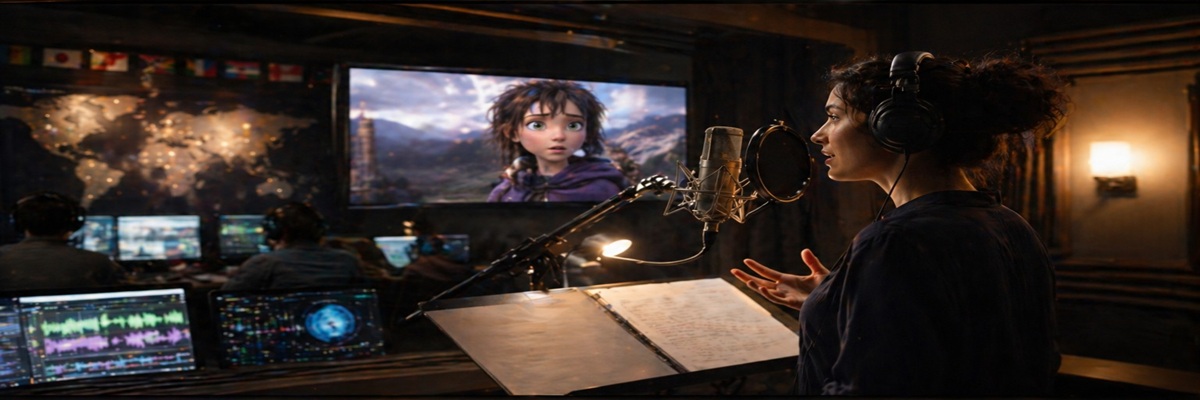
The recent passing of voice actor Benoît Rousseau brought attention to a part of the industry that rarely enters public conversation. His work connected to globally recognized titles like The Simpsons, reaching audiences far beyond a single region. Yet like many dubbing actors, his name was not widely known outside professional circles.
This contrast highlights a defining aspect of dubbing work. Voices travel across countries, languages, and platforms, but the people behind them often remain out of view. Despite playing a central role in how stories are experienced worldwide, dubbing actors continue to operate largely behind the scenes.
Dubbing Voices Across Global Entertainment
Modern entertainment is built on global distribution. Films, television series, and streaming content are released across multiple regions, often simultaneously. For that to work, content must be adapted into different languages without losing its original intent.
Dubbing makes this possible.
Major franchises rely heavily on localized voice performances. Animated series, live-action films, and large-scale streaming productions all use dubbing to reach wider audiences. A single character may have multiple voice actors across different regions, each delivering the same role in a way that fits the language and cultural context.
For viewers, this process is seamless. The character feels consistent, even though the voice may change depending on the version being watched. This consistency depends on the skill of dubbing actors, who align their performances with the timing, emotion, and rhythm of the original.
As global distribution continues to expand, dubbing has become a standard part of production rather than an afterthought. It ensures that content can travel while remaining accessible to audiences everywhere.
Why These Voices Are Rarely Recognized
Despite their widespread reach, dubbing actors rarely receive the same level of recognition as on-screen performers or original voice actors.
One reason lies in how productions are presented. Marketing and promotion typically focus on the original cast, even when localized versions are widely consumed. Viewers often associate a character with the first version they encounter, without considering the adaptation behind it.
Credits also play a role. While dubbing actors are credited, those credits are not always prominently displayed or easily accessible. In many cases, they appear in localized listings that are not part of the main promotional material.
There is also a perception factor. Audiences tend to view dubbed performances as secondary to the original, even though they require their own level of interpretation and skill. This perception can limit visibility, regardless of the quality of the work.
The result is a gap between impact and recognition. Dubbing actors contribute to global storytelling, but their presence remains largely understated.
The Role Dubbing Actors Play in Shaping Characters
Dubbing is not a process of simple replication. It involves performance decisions that shape how a character is perceived in different languages.
Actors must match the timing of the original dialogue while delivering lines that feel natural within the new language. This requires precise control over pacing and phrasing. At the same time, the emotional tone must align with the on-screen performance.
Small variations can influence how a character is understood. A slight change in delivery can shift the balance between humor and seriousness, or between confidence and hesitation. These adjustments are often subtle, but they contribute to the overall experience.
Because of this, dubbing actors become part of the storytelling process. They are not just translating dialogue, but interpreting it in a way that works for a different audience.
Across languages, the same character can carry slightly different qualities based on these interpretations. The core identity remains intact, but the performance adapts to fit the context.
A Career Built Without Public Recognition
Dubbing careers are often defined by consistency rather than visibility. Actors may spend years working across multiple projects, building a body of work that reaches large audiences without direct recognition.
These careers are typically long-term. Dubbing actors are frequently cast in recurring roles, providing continuity for characters across seasons, films, or franchise expansions. This creates a stable workflow, even if it does not come with widespread public attention.
Benoît Rousseau’s career reflects this pattern. His work across major productions placed him within globally recognized content, yet his contributions remained part of a broader system rather than a public-facing identity.
This type of career is common in dubbing. It is built on reliability, adaptability, and the ability to deliver consistent performances across different projects and formats.
While the work may not be highly visible, its reach is significant. Audiences engage with these performances daily, often without realizing the level of craft involved.
Dubbing actors play a central role in how global audiences experience stories. Their work allows characters and narratives to move across languages while maintaining coherence and impact.
Even without widespread recognition, their influence is built into the content itself. Every localized version of a film or series carries the imprint of the voice actors who brought it to life for a new audience.
That presence may remain largely unseen, but it continues to shape how stories are heard around the world.
