
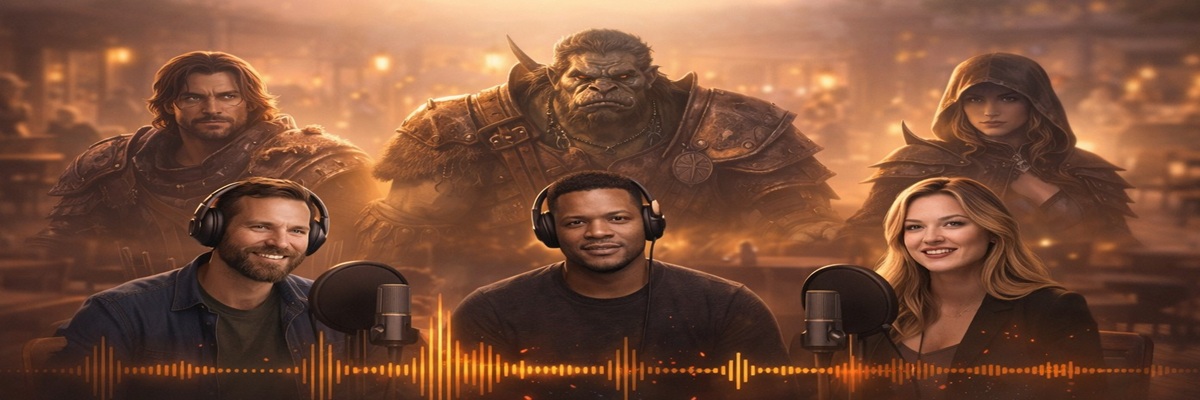
Pearl Abyss’ upcoming open-world action RPG Crimson Desert is positioning itself as one of the most ambitious fantasy releases in development, and much of that ambition is anchored in its voice cast. In a recent interview published on the Epic Games Store, members of the game’s voice ensemble discussed their approach to character work, performance capture, and the scale of the project. Supporting coverage from IGN Fan Fest 2026 and additional reporting highlights just how experienced the cast is — and how intentionally the studio has leaned into human performance over AI-generated voices.
With talent connected to major titles like Cyberpunk 2077, Baldur’s Gate 3, and Arcane, Crimson Desert is drawing from actors who are no strangers to large-scale narrative games. At a time when artificial voice tools are increasingly discussed in development pipelines, Pearl Abyss has emphasized performance authenticity as central to the experience.
The Cast of Crimson Desert and Their Industry Backgrounds
The voice cast of Crimson Desert includes performers with deep résumés in role-playing games, animation, and cinematic storytelling. According to reporting around the project, the ensemble features actors whose previous work spans some of the most celebrated recent RPGs.
Several cast members have credits in Cyberpunk 2077, CD Projekt Red’s sprawling sci-fi RPG known for its dense narrative and layered character arcs. That game’s voice work was praised for balancing emotional nuance with expansive world-building. Experience in such a dialogue-heavy, choice-driven environment prepares actors for similarly complex roles in Crimson Desert.
Others in the cast have worked on Baldur’s Gate 3, a title widely recognized for raising expectations around voice performance in RPGs. The Larian Studios project featured fully voiced companions, branching storylines, and intricate character interactions. Actors emerging from that production bring experience in reactive storytelling, where tone shifts depending on player decisions.
There are also performers associated with Arcane, the animated series praised for its emotionally grounded performances and layered character development. Work in high-quality animation requires precision in vocal delivery, often without the physical context of a full live-action set. That discipline translates well into fantasy RPGs, where characters inhabit expansive, stylized worlds.
In interviews, actors involved in Crimson Desert have described the scale of the project as immersive and physically demanding. Performance capture sessions require blending vocal intensity with physical motion, often in extended takes. For seasoned RPG actors, that hybrid process — voice plus movement — is increasingly standard.
The casting choices signal that Pearl Abyss is aiming for cinematic depth rather than minimalist dialogue. Bringing together talent with backgrounds in large ensemble RPGs suggests a deliberate effort to elevate character relationships and emotional stakes.
Building Character Through Performance
In the Epic Games Store interview, voice actors discussed how they approached their roles within the world of Crimson Desert. The game’s setting, filled with political conflict and shifting alliances, demands performances that can balance intensity with vulnerability.
Actors noted that collaboration with directors and developers was central to shaping their characters. Performance capture sessions allowed them to refine gestures and vocal rhythms simultaneously. This integrated approach often results in more cohesive storytelling because physicality informs vocal tone.
For open-world RPGs, performance must carry across dozens of hours of gameplay. Characters evolve, confront betrayal, and respond to player actions. Actors working on projects like Baldur’s Gate 3 are accustomed to recording multiple variations of lines to reflect branching narratives. That same skill set appears to be influencing the development of Crimson Desert.
Behind-the-scenes footage showcased at IGN Fan Fest 2026 further highlighted the effort being invested in authenticity. The cast’s experience with cinematic RPGs enables them to navigate long-form storytelling arcs rather than isolated scenes. This depth of experience can help sustain emotional consistency throughout expansive campaigns.
By emphasizing performance capture and experienced voice talent, the studio is underscoring that character development is not an afterthought. It is a structural component of the game’s design.
Crimson Desert’s Decision to Avoid AI Voices
One of the more notable aspects of coverage surrounding Crimson Desert is the studio’s reported stance on AI-generated voices. In an environment where artificial voice replication tools are increasingly discussed in game development, Pearl Abyss has leaned toward a fully human cast.
Reports indicate that the game does not rely on AI-generated voice performances. Instead, the emphasis remains on traditional recording sessions and performance capture. This decision places the focus squarely on actors’ craft rather than algorithmic reproduction.
The choice stands out amid broader industry conversations about efficiency and automation. While AI tools are often framed as cost-saving measures or ways to scale content quickly, narrative-driven RPGs frequently depend on emotional authenticity. For games built around character arcs and moral tension, vocal subtlety can be as critical as visual design.
By casting established actors and committing to performance-driven recording, Crimson Desert aligns itself with projects that treat voice acting as a creative cornerstone rather than a technical afterthought.
What This Cast Means for Crimson Desert’s Narrative Scope
The combination of high-profile RPG veterans and a commitment to human performance suggests that Crimson Desert is aiming for more than spectacle. Pearl Abyss appears intent on building a world where characters resonate beyond combat mechanics and environmental scale.
Experienced voice actors bring more than name recognition. They bring familiarity with recording large volumes of dialogue, adapting to narrative shifts, and sustaining emotional arcs over lengthy campaigns. In open-world RPGs, where players can spend dozens of hours interacting with companions and rivals, that endurance matters.
The success of titles like Baldur’s Gate 3 has raised expectations around voice performance. Fully voiced interactions and nuanced delivery are now seen as standard for premium RPG experiences. By drawing from that pool of talent, Crimson Desert positions itself within that same narrative tier.
As development continues, the spotlight on its cast indicates that voice acting will be central to its identity. In a genre defined by world-building and player agency, the human voices guiding that journey remain among the most influential elements. With a cast drawn from some of the industry’s most respected narrative projects, Crimson Desert is signaling that its storytelling ambitions extend well beyond the battlefield.
