
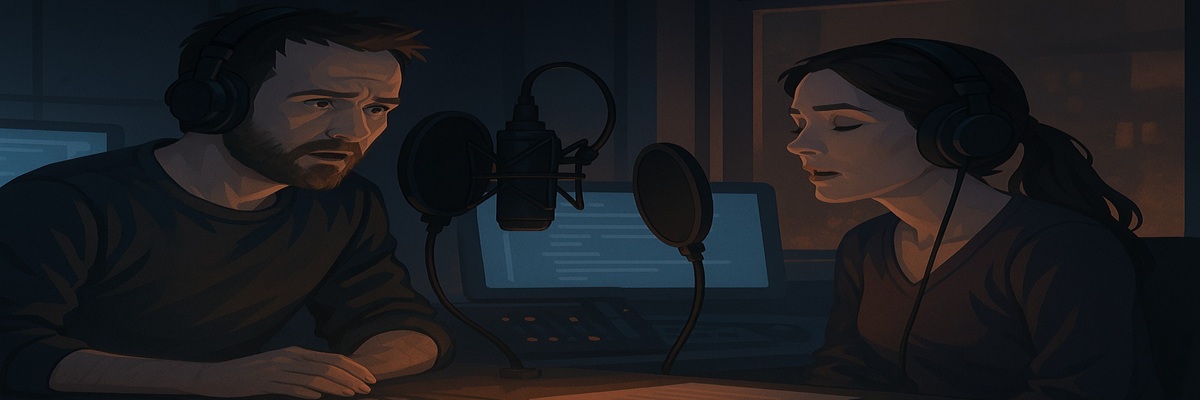
A Different Kind of Release, a Deeper Kind of Connection
When Dispatch began releasing earlier this year, it didn’t just introduce another narrative-driven game; it introduced a new rhythm for storytelling. Rather than dropping all its content at once, the title unfolded in episodes, each building tension and depth while giving players space to reflect on what they’d just experienced. With episodes three and four recently launched, Dispatch has completed the kind of slow-burn rollout that mirrors prestige television more than traditional gaming.
At its core, the project is a hybrid of interactive thriller and human drama. It centers on decision-making, dialogue, and emotion rather than combat or spectacle. But what truly sets Dispatch apart is its sound, the way it leans on the voice performances to guide every emotional shift.
That’s where the magic lies. While the industry often relies on visuals or mechanics to hold attention, Dispatch puts faith in its cast, a group of acclaimed voice actors and screen performers whose delivery makes silence feel like part of the script.
Inside the Game’s Design Philosophy
The developers behind Dispatch took a creative risk by structuring the game like a serialized drama. Each episode releases on its own schedule, allowing time for feedback, refinement, and emotional buildup. This format isn’t just a marketing strategy; it’s part of the storytelling itself. Players experience the same uncertainty and anticipation as the game’s protagonist, waiting for the next chapter to arrive.
The design reflects the team’s larger goal: to craft an experience where listening is as important as acting. The player’s role is less about solving puzzles and more about interpreting tone a raised voice, a pause, a breath.
That design choice is intentional. It places enormous responsibility on the actors, demanding not just technical delivery but emotional precision. Every choice in performance influences how the player perceives truth, guilt, and empathy.
The Studio That Believes in Sound
Behind the project is a studio that has treated voice and sound not as production details, but as the foundation of storytelling. From the first recording sessions, the team focused on capturing realistic vocal imperfections, overlapping dialogue, and even ambient reactions that would normally be edited out.
The developers approached each episode like a film shoot, recording in real environments when possible and using film-grade sound mixing. Their guiding philosophy was simple: if the player only listened, they should still understand everything.
This emphasis on sound design allowed the studio to blend gaming and cinema seamlessly. Rather than relying on cutscenes, emotion is carried through performance, a sigh, a whisper, a moment of silence that speaks volumes.
It’s a choice that reflects confidence in the voice actors themselves. Dispatch’s dialogue wasn’t built around exposition; it was written for interpretation. The actors had to live inside the script rather than simply perform it.
A Cast That Brings the Script to Life
Few casts in gaming this year have generated as much anticipation as Dispatch’s. Leading the lineup is Aaron Paul, returning to voice work after years of success on screen. Known for emotionally intense roles in Breaking Bad and Westworld, Paul’s transition to voice acting has been uneven in the past. While praised for his work in BoJack Horseman, he received mixed reviews for earlier game projects. In Dispatch, however, he finds balance: his delivery carries the same conviction as his live-action performances, tempered with the restraint that pure voice work demands.
Sharing the spotlight is Laura Bailey, one of the most respected performers in modern gaming. Her name is synonymous with versatility; from The Last of Us Part II to World of Warcraft, she has proven capable of carrying entire emotional arcs with her voice alone. In Dispatch, she channels that range into a grounded, human tone, guiding scenes that rely as much on empathy as intensity.
They’re joined by a supporting ensemble that includes several veteran voice talents, each bringing depth to side characters that feel as carefully crafted as the leads. Together, they create a world that sounds lived-in, where even a passing remark can carry tension or tenderness.
According to interviews with the cast, many of these performances were recorded in isolation, often without direct interaction between actors. The challenge was to sound connected without ever being in the same room. For professionals like Paul and Bailey, that meant trusting instinct, pacing, and the direction of a sound team that treated every session like a rehearsal for film.
The Art of Acting Without a Face
Voice acting in Dispatch isn’t about volume; it’s about precision. Every breath and hesitation has meaning. With limited visuals, the actors had to rely entirely on sound to express fear, doubt, and fatigue.
Aaron Paul reportedly re-recorded several key lines to refine emotional continuity between episodes. Instead of traditional “video game energy,” the performances are subdued, almost fragile at times. That realism makes the tension hit harder. Players don’t hear heroes or villains; they hear people under pressure.
For Laura Bailey, the project was a return to intimate storytelling. Her approach here is closer to film acting than gaming, measured, layered, and deeply human. In interviews, she described Dispatch as one of the most emotionally demanding roles of her career because every emotion had to be conveyed through voice alone.
This approach also highlights an important evolution in voiceover work. As technology improves, audiences now expect emotional authenticity, not just clear diction. The performances in Dispatch meet that demand, proving that even without motion capture or elaborate visuals, pure voice can still tell the truth.
Where Dispatch Fits in the Future of Voice-Led Storytelling
With Dispatch, the line between video game and drama has blurred further than ever. It’s a reminder that storytelling in games doesn’t always need sprawling worlds or visual spectacle; sometimes it just needs great writing and the right voices to bring it to life.
The episodic structure has already influenced how players engage with narrative-driven titles. Instead of a single binge, audiences have followed Dispatch like a series, discussing performances, theories, and emotional beats after each new release. This approach not only sustains momentum but also gives space for its voice actors to be appreciated as performers in an unfolding drama rather than background narrators.
The game’s success also underscores a shift in how developers view audio. For years, voice acting was considered a late-stage production element. Dispatch proves it can be the starting point, the framework on which a story is built.
Looking ahead, projects inspired by this model may treat actors as co-authors, shaping tone and pacing before animation even begins. And for players, it marks a refreshing reminder that storytelling isn’t about spectacle, it’s about sound that moves you.
Dispatch may not look like a blockbuster, but it sounds like one, and that’s precisely why it stands apart.
