
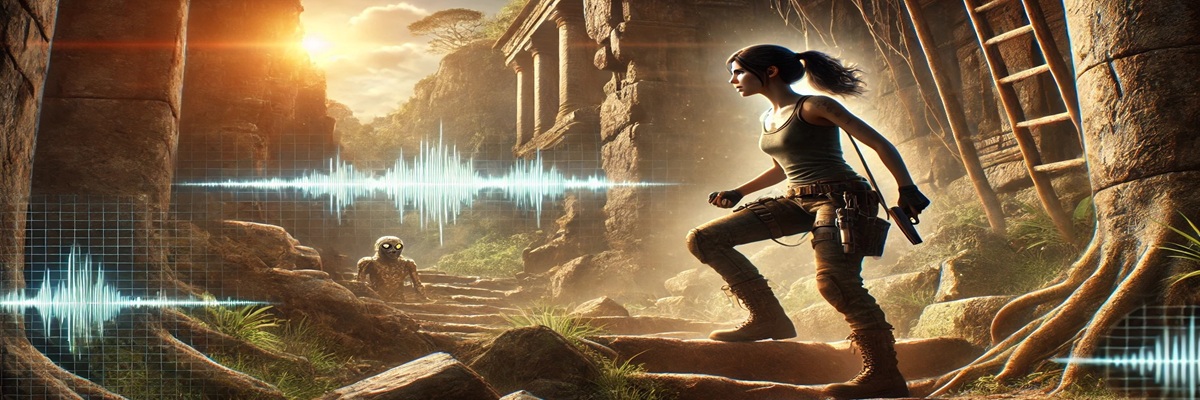
The remastered editions of Tomb Raider games 4 through 6 are at the center of a growing dispute over artificial intelligence and performers’ rights. Françoise Cadol, the longtime French voice of Lara Croft, has filed legal action against developer Aspyr Media, alleging that her voice was digitally replicated without consent for the new Tomb Raider I-III Remastered collection, which includes updated content from later titles. According to Cadol, certain new dialogue—particularly revised tutorial and control instructions—was generated using AI trained on her past performances.
Cadol, who has voiced the iconic adventurer in French since the late 1990s, revealed that she became suspicious after fans pointed out subtle differences in some lines following a recent update. Players noticed that specific instructions sounded off, with a delivery that felt slightly mechanical compared to Cadol’s earlier recordings. On closer listening, she agreed, concluding that these segments were not her work but rather an AI imitation.
The issue surfaced after a patch modified parts of the game to reflect new control schemes. Cadol maintains that no one from Aspyr sought her approval for any new recordings or discussed creating AI generated dialogue. In response, she issued a cease and desist letter and confirmed she is pursuing legal remedies. Her move quickly gained attention across the gaming community, where concerns about AI misuse in creative industries have been intensifying.
Evidence of a broader pattern soon emerged. Lene Bastos, who provides Lara Croft’s Brazilian Portuguese voice, reported similar concerns. Bastos stated that Aspyr privately admitted that an external development partner had used AI for certain lines and promised to remove those elements. Though Aspyr has not issued a full public statement, the reported private acknowledgment has fueled debate about how much the developer knew and when.
Industry voices are weighing in as well. Paul Douglas, co-creator of the original Tomb Raider, described the situation as “not cool” and “not classy,” underscoring the sentiment that performers’ voices are an essential part of a character’s identity. Fans echo that view, emphasizing that Cadol’s performance helped define Lara Croft for French speaking audiences and deserves the same protection as any on screen likeness.
The controversy highlights a key question facing modern entertainment: how to balance technological advances with artists’ rights. AI can seamlessly replicate voices, but without clear rules and transparent consent, it can also undermine trust and livelihood. As the dispute unfolds, many in the gaming and voice acting worlds are watching closely, seeing it as a potential landmark case for how AI generated performances are treated legally and ethically.
Broader Implications for the Gaming Industry
The implications of Françoise Cadol’s lawsuit go well beyond a single game update. Her case highlights how quickly artificial intelligence can blur the lines between creative collaboration and unauthorized reproduction. While AI tools are increasingly common for game development—speeding up tasks like environmental design or bug testing—using them to reproduce an actor’s voice without consent introduces legal and ethical risks that many feel the industry has yet to fully address.
Voice actors and unions have been warning for years about exactly this scenario. Contracts for dubbing and voiceover work often grant studios rights to existing recordings, but those agreements rarely anticipate machine generated replicas that can create entirely new dialogue. Without explicit protections, a performer’s voice could, in theory, be reused indefinitely without additional payment or even knowledge. Cadol’s legal challenge therefore resonates far beyond Tomb Raider, signaling to both actors and developers that clearer contract language and stronger oversight are urgently needed.
Fans, too, are speaking out. Social media threads and gaming forums have filled with posts supporting Cadol and fellow actor Lene Bastos, whose Brazilian Portuguese performance was reportedly cloned in a similar way. Players have shared side by side clips comparing authentic lines with those suspected to be AI generated, noting subtle differences in pacing and emotion. Many argue that these discrepancies break immersion, demonstrating that even advanced AI struggles to capture the human nuance that defines beloved characters like Lara Croft.
Aspyr Media, which handled the Tomb Raider I–III Remastered collection, has remained largely silent publicly. Reports suggest that the studio privately acknowledged AI involvement and promised to remove any disputed lines, but no formal statement has been released. This limited response has drawn criticism from industry observers who believe transparency is essential to rebuild trust with both performers and players. Clear communication, they argue, would help set standards for how similar issues should be addressed in the future.
The controversy also places a spotlight on how games preserve their cultural legacy. The original Tomb Raider titles are more than entertainment; they are milestones in gaming history. By reintroducing these classics to new audiences, remastered editions carry a responsibility to maintain the integrity of the performances that helped make them iconic. Replacing or altering those performances without consent risks diminishing that legacy and undermines the very authenticity that remasters are meant to celebrate.
As Cadol’s legal action proceeds, its outcome could influence contracts, production practices, and even international copyright norms. Whether through new industry guidelines or legislative action, the case is expected to shape how AI generated voices are handled in future games and other media. For now, players, actors, and developers alike are watching closely, aware that the resolution may set a precedent for how creative rights are protected in an age of rapid technological change.
Impact on Storytelling and Performer Relationships
The debate over AI and voice rights is also sparking discussion about the future of storytelling in games. For decades, human performances have given video game characters depth and emotional resonance, helping franchises like Tomb Raider remain relevant across generations. Cadol’s portrayal of Lara Croft has been part of that foundation, carrying the character through countless adventures and making her instantly recognizable to French speaking audiences. Fans argue that a digital replica, no matter how sophisticated, cannot replace the subtle emotion that comes from a seasoned performer.
Industry veterans share this concern. Game developers and fellow actors note that the trust between studios and talent depends on open communication and fair agreements. When a voice is recreated without permission, it can damage relationships and discourage actors from lending their voices to future projects. Some developers now call for stronger internal review processes to ensure that any AI use is transparent and fully approved by all performers involved.
Legal experts suggest that Cadol’s lawsuit could have ripple effects across entertainment and tech. If courts side with her, companies might face stricter requirements for disclosing and licensing AI generated content. This could reshape how contracts are written, with explicit clauses covering synthetic speech, digital likenesses, and machine learning applications. Even outside gaming, industries such as film, television, and audiobooks are watching closely, aware that the ruling could influence how they handle similar technology.
Meanwhile, the Tomb Raider community continues to voice its support. Players have organized petitions and social media campaigns urging Aspyr Media to credit and compensate the affected actors. Many long time fans view this as a matter of artistic integrity as well as legal fairness. They argue that respecting the original performers is essential to preserving the spirit of a franchise that has spanned more than two decades and inspired millions worldwide.
Aspyr has not yet released a comprehensive public statement beyond the reported private assurances to remove disputed audio. Observers believe that a clear, detailed explanation will be crucial for regaining trust and demonstrating a commitment to ethical standards. Without it, speculation and frustration are likely to grow, potentially affecting the reception of future releases or updates.
A Case That Could Shape AI and Creative Rights
As technology continues to advance, the line between human and artificial performances will only become more complex. The outcome of Françoise Cadol’s case may provide much needed clarity, setting legal and professional benchmarks for how AI can and cannot be used in creative work. For now, her fight serves as a powerful reminder that while technology can enhance storytelling, the human voice remains irreplaceable at the heart of truly memorable characters.
