
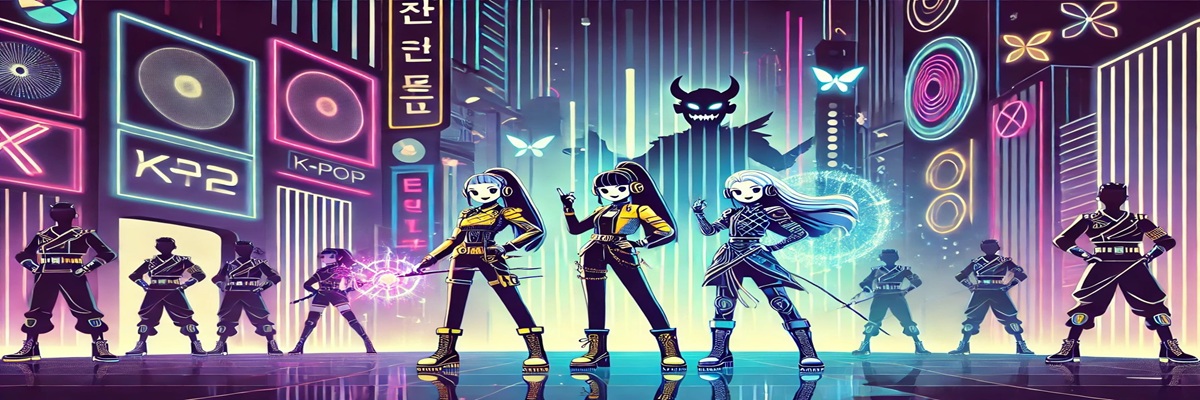
The highly anticipated animated film K-Pop: Demon Hunters is making waves ahead of its release—not just for its stylish visuals and genre-bending story, but for its bold casting choices. Blending the worlds of music and voice acting, the film features a standout ensemble of K-pop idols and professional voice talent, giving fans of both animation and Korean pop culture something to buzz about.
Directed by Maggie Kang (The LEGO Ninjago Movie) and Chris Appelhans (Wish Dragon), the movie follows a fictional K-pop girl group that leads a secret double life: by day, international music stars; by night, fierce demon slayers. The concept leans into the hyper-polished aesthetics of Korean pop while infusing it with supernatural action and Eastern mythology—a balance that demands both vocal intensity and performance charisma.
To match that ambition, the production has assembled a voice cast that merges rising K-pop stars with accomplished English-speaking performers. The result is a project that not only breaks genre conventions, but also challenges traditional casting norms in animation.
Meet the Cast: Idols and Actors Aligned
At the heart of K-Pop: Demon Hunters are three leading characters, each voiced by performers with strong connections to the Korean entertainment world:
- Mi-young, the group’s fearless leader and main vocalist, is voiced by Jennie Kim, better known as Jennie from BLACKPINK. While Jennie is no stranger to global stardom through music, this marks one of her first forays into voice acting. Her character balances poise, authority, and underlying vulnerability—traits fans already associate with her stage presence.
- Ji-soo, the team’s moody lead dancer and demon-slaying strategist, is voiced by Sherry Cola, the Chinese-American actress known for roles in Good Trouble and Joy Ride. Her experience in comedy and drama gives Ji-soo a layered performance that bounces between sarcasm and seriousness.
- Min-seo, the youngest member and tech genius of the group, is played by Stephanie Hsu, an Oscar-nominated actress for Everything Everywhere All at Once. With strong roots in both stage and screen, Hsu brings playful energy and grounded emotion to the role.
These characters form the emotional core of the film, and each performer adds a distinct flavor to the group’s chemistry—whether it’s through comedic timing, heartfelt dialogue, or subtle vocal nuance.
Blending Genres: Music Meets Mythology
K-Pop: Demon Hunters isn’t just casting for name recognition—it’s casting for synergy. The film’s entire concept hinges on an authentic fusion of two fast-paced, high-pressure worlds: the glitzy performance culture of K-pop and the shadowy action of demon-slaying fantasy. To make this believable, the cast needs to do more than just deliver lines—they need to sound like pop idols and battle-tested warriors.
This is where the inclusion of real K-pop talent like Jennie Kim becomes more than a marketing move. Her voice doesn’t just lend credibility to the group’s music segments; it grounds the entire film in a soundscape that feels emotionally and culturally aligned with the world it portrays. Meanwhile, trained voice actors like Sherry Cola and Stephanie Hsu anchor the story with performance range, knowing when to heighten tension, pull back for comedy, or deliver raw, grounded moments of vulnerability.
The supporting cast also reflects this balance. While full details are still emerging, it’s confirmed that the film includes other idol cameos and character roles voiced by Korean-American performers, many of whom have backgrounds in musical theater or multilingual voiceover work. This layered approach not only broadens the representation behind the mic—it brings a musicality to every scene that a purely traditional voice cast might struggle to achieve.
Elevating Voice Acting in Pop Culture Storytelling
In an era where animation is becoming increasingly international, K-Pop: Demon Hunters is positioning itself as a benchmark for what modern, culturally attuned casting can look like. Rather than defaulting to celebrity stunt casting with little connection to the material, the film’s production team appears to have taken care to match voice with background, and energy with authenticity.
This choice may also help elevate the visibility of voice acting as a craft. For many audiences, especially younger fans coming from the K-pop world, this may be their first introduction to voice acting beyond traditional anime or cartoons. Hearing familiar idols take on dramatic or action-packed vocal performances could help highlight the range and rigor of VO work—while also drawing attention to the skill required to balance dialogue, emotion, and musical performance in a single role.
With the global K-pop fanbase continuing to expand—and animated storytelling reaching wider audiences than ever through streaming platforms—K-Pop: Demon Hunters could mark a cultural inflection point. Not only does it celebrate the star power of Korean music, but it also places voice actors and vocal performers in the spotlight as essential creative forces.
A Global Project With a Global Audience
While K-Pop: Demon Hunters centers on Korean culture and aesthetics, its production and distribution strategy is designed for a truly global audience. The film will be released in both English and Korean, with select international markets receiving dubbed versions featuring locally recognized voice talent. This multilingual approach reflects not just the worldwide popularity of K-pop, but also the growing importance of localized voice casting in global animation.
Studios have increasingly come to understand that localization is not simply a matter of translation—it’s about preserving the emotional and cultural integrity of a performance. By anchoring the English-language cast with Asian-American talent and integrating K-pop stars into the core ensemble, the filmmakers signal a deliberate effort to make the story resonate across borders without losing authenticity.
Streaming platforms and theatrical distributors are already taking notice. Buzz around the film has picked up on social media thanks to early behind-the-scenes clips, cast interviews, and soundtrack teasers. Much of that excitement is fueled by the novelty of watching familiar K-pop idols step into animated roles—a crossover that’s still rare, especially in mainstream Western animation.
For the voice acting industry, K-Pop: Demon Hunters represents a shift toward broader cultural participation. It’s a project where casting is not just inclusive—it’s essential to the narrative. It acknowledges that who is behind the mic matters just as much as the visuals on screen.
Voice Acting at the Forefront of Cross-Cultural Storytelling
As animation continues to evolve into a global storytelling medium, K-Pop: Demon Hunters sets a compelling precedent: voice actors and vocal performers can serve as bridges between cultures, industries, and fanbases. The film’s high-energy concept may be fantastical, but its creative choices reflect very real shifts in how voice casting is being approached in modern media.
By blending the vocal discipline of trained actors with the charisma and vocal power of K-pop artists, the project expands the definition of what voice acting can be—and who can do it. It also gives audiences a richer, more layered listening experience: one that captures the dynamic energy of a concert, the stakes of a battle, and the heart of a character arc all in one.
With a release date expected later this year and more casting announcements on the way, K-Pop: Demon Hunters is shaping up to be more than a stylish animated film. It may just be a new blueprint for voice-driven pop culture storytelling—powered by talent that knows how to sing, act, and slay.
