
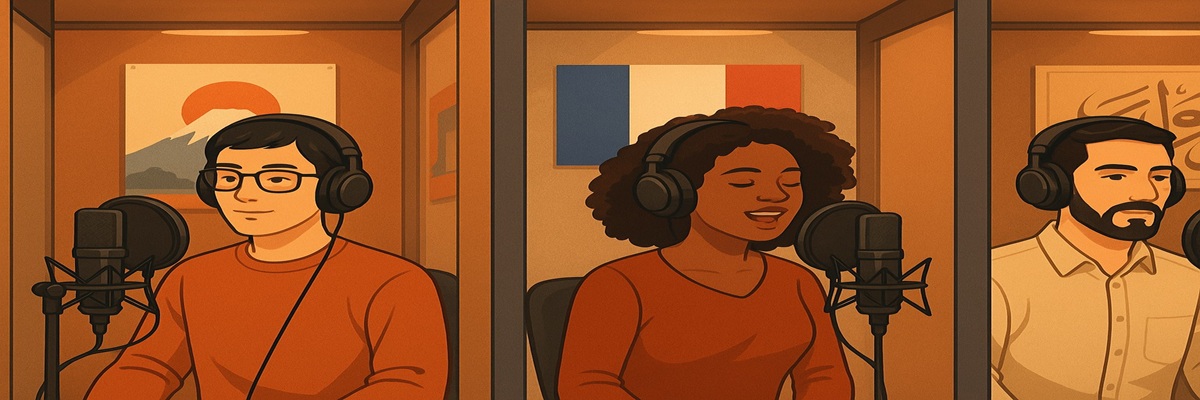
Dubbing has always played a crucial role in the global spread of film, television, and animation. But in 2025, international dubbing is experiencing a transformation not just in volume, but in its visibility, quality standards, and cultural importance. As streaming platforms compete for worldwide audiences and international franchises take center stage, dubbing is no longer an afterthought; it’s a central component of global media strategy.
This shift is expanding opportunities for voice actors around the world. Localization studios are investing in talent, training, and technology to meet rising expectations. And for many voice performers, dubbing has become not only a consistent career path but a powerful way to shape how audiences experience storytelling across languages and borders.
A Global Boom Driven by Streaming
The rise of international streaming has fundamentally changed how and when dubbing is produced. Netflix, Amazon Prime Video, Disney+, and regional platforms like Viki and Shahid are distributing content across continents at unprecedented speeds, often requiring 10 to 30 different language versions per release.
What once was an optional localization path for studios is now standard. Shows and movies launch with multiple dubbed versions simultaneously, and audiences increasingly expect high-quality native-language performance, not generic voiceovers or subtitled fallback options.
This surge in demand is creating long-term work for voice actors in major hubs like Mexico City, Madrid, Paris, São Paulo, Seoul, and Mumbai, as well as in emerging centers across Southeast Asia, Eastern Europe, and Africa.
The Voice Actor as Cultural Interpreter
Effective dubbing goes beyond translation. It requires performance choices that reflect not only the script but also the cultural context and character depth. Voice actors are being asked to make interpretive decisions to convey not just what a line means, but how it should feel in a different language and cultural setting.
This role as a “cultural interpreter” is what distinguishes great dubbing from adequate localization. Talented dubbing actors are skilled in tone-matching, emotional nuance, and pacing, adjusting their delivery to reflect how characters would express themselves in their own cultural landscape.
In 2025, studios are prioritizing this layer of performance more than ever. Directors are giving voice actors more room to adapt phrasing, improvise around colloquialisms, and ensure the dubbed version carries the same rhythm and intention as the original.
Celebrity Dubs and the Push for Local Star Power
Another notable trend in international dubbing is the rise of celebrity casting in local markets. Just as Hollywood studios often cast recognizable names for English-language animated films, international releases are now being dubbed by well-known regional actors, musicians, and influencers.
This trend boosts viewership and strengthens regional identity, but it also raises questions about voice acting as a craft. Many professional voice actors have voiced concerns over being displaced by celebrities with limited vocal training. However, when handled with care, especially when paired with skilled dubbing directors and vocal coaches, celebrity dubs can draw attention to a production without sacrificing quality.
Some studios now blend both approaches: casting stars for lead roles and supporting them with trained dubbing actors to round out the ensemble and ensure consistency.
Tech-Assisted Dubbing and the Human Touch
The dubbing world is also navigating the arrival of new technologies. AI tools are being tested for voice replication, script syncing, and even automatic lip-matching. While these tools may streamline some elements of production, they’re far from replacing human performance.
In fact, many production houses are investing more in voice actor training, accent coaching, and script development to enhance performance. Some are even experimenting with hybrid dubbing models, where AI handles initial line alignment and voice actors come in to record final, expressive passes.
What’s clear is that emotion, authenticity, and cultural understanding remain irreplaceable. Studios are recognizing that only a skilled human actor can deliver a line with the right weight, breath, timing, and intention, particularly when the emotional arc of the character is subtle or nonverbal.
A Rise in Global Recognition
In the past, dubbed performances were rarely credited outside their home market. But that’s changing. Streaming services now display full dubbing cast lists by language. Fans of international shows actively follow voice actors from specific dubs. Entire online communities discuss performances, character pairings, and vocal deliveries, comparing dubbed versions the same way they once compared musical arrangements or sound design.
For many multilingual audiences, the dubbed version is the version the one that introduced them to the story. This has led to increased recognition of voice actors as public figures in their own right, complete with fan followings, podcast interviews, and social media spotlights.
Events like the Tokyo Anime Awards Festival, the Spanish Premios Doblaje, and India’s Dubbing Artists Guild Awards have grown in both prestige and attendance, further validating voice acting as a recognized and celebrated craft across languages.
Career Longevity and International Work
For voice actors, dubbing offers something many other sectors don’t: consistency. While commercial and promo work can fluctuate with market trends, dubbed content, especially in serialized TV and anime, can provide long-term character roles that span years.
Many dubbing actors build multi-year careers voicing the same character across seasons, spin-offs, or video game adaptations. This continuity not only fosters voice consistency for fans but also builds strong actor-character bonds.
More experienced voice actors are also being tapped for international directing and coaching roles, helping train new talent, standardize dubbing processes, or consult on cultural translation for major projects.
Challenges Ahead: Equity and Representation
Despite the progress, the dubbing industry still faces challenges. Pay discrepancies between regions remain a concern. In some markets, voice actors are underpaid despite the global reach of their work. Advocates are calling for fairer contracts, better residual structures, and union support where it’s lacking.
There’s also a need for better representation in casting. Authenticity matters, and that includes hiring native speakers for dialects, languages, and identities portrayed in international content. Some markets are further ahead on this front than others, but awareness is growing.
In 2025, a global conversation is underway not just about who gets to dub, but about how those voices are valued.
A Global Stage for the Voice
The expansion of international dubbing has elevated the voice actor from behind-the-scenes contributor to cultural ambassador. Whether delivering dialogue for a K-drama in Italian, an anime series in Portuguese, or a French art film in Korean, voice actors are carrying stories across borders one carefully performed line at a time.
As media consumption continues to globalize, dubbing will only grow more important and more influential. The voice actor in 2025 is no longer just serving the story. They’re shaping how the world hears it.
